Provenance
Conrad Martin Metz (died 1827) [Lugt 598b]; sold, Philips, London, May 4-5, 1801, Metz estate sale. Johann Dominik Bossi (died 1853), Munich; by descent to his daughter, Maria Theresa Caroline Bossi (died 1881), and her husband, Carl Christian Friedrich Beyerlen (died 1881), Stuttgart [Knox 1980]; sold, H. G. Gutekunst, Stuttgart, March 27, 1882, Bossi-Beyerlen sale to Dr. O. Eisenmann, Director of the Gallery at Cassel on behalf of Wilhelm Lübke (died 1893), Stuttgart [Knox 1980]; probably sold by the estate of Wilhelm Lübke to Joseph Baer and Sons, Frankfurt [Wendland’s oral history and Knox 1980]; sold to Dr. Hans Wendland, Lugano, after 1919 [Wedland’s oral history and Knox 1980]. Sold by A and R Ball, New York, to the Art Institute, 1942.
Accession Number
113266
Medium
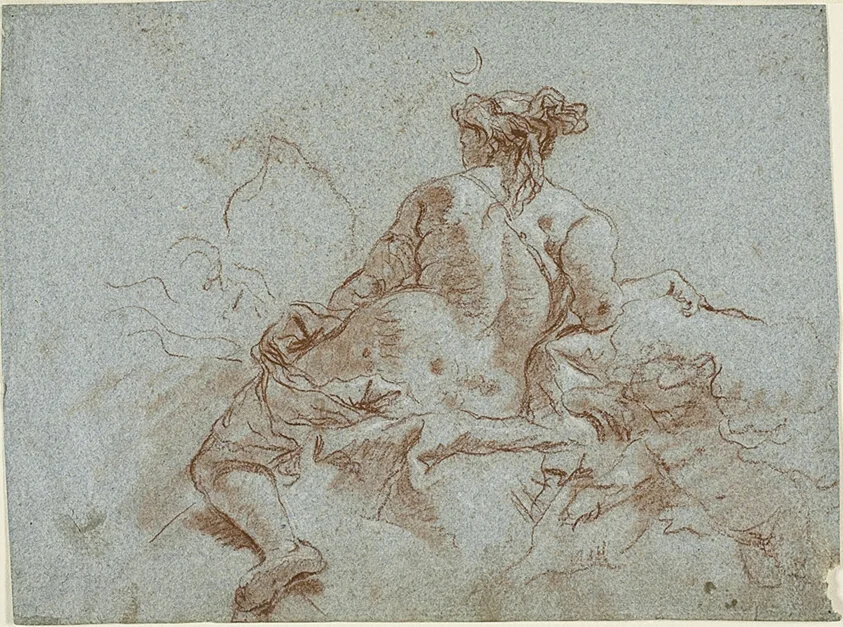
Red chalk, heightened with touches of white chalk, on blue laid paper
Dimensions
17.9 × 24 cm (7 1/16 × 9 1/2 in.)
Classification
chalk
Credit Line
Simeon B. Williams Fund
Background & Context
Background Story
Giovanni Battista Tiepolo's "Study for Detail: The Goddess Diana" (1750–59) is a red chalk drawing heightened with white chalk on blue laid paper. This is a preparatory study for the figure of Diana, the Roman goddess of the hunt, in one of Tiepolo's ceiling frescoes or decorative schemes. Diana is shown with her characteristic attributes—perhaps a bow, arrows, a crescent moon in her hair, or accompanied by a hunting dog. The red chalk on blue paper technique is characteristic of Tiepolo's most beautiful drawings: the warm red of the chalk (sanguine) contrasts with the cool blue of the paper, while the touches of white chalk add highlights that give the figure luminosity and three-dimensionality. This study reveals Tiepolo's working process: before painting a figure in fresco, he would make detailed studies of individual figures, working out the pose, the drapery, and the play of light before integrating the figure into the larger composition. The goddess Diana, with her associations of moonlight, hunting, and virginity, was a popular figure in Baroque and Rococo decorative schemes.
Cultural Impact
Tiepolo's preparatory studies for his frescoes and decorative works reveal the meticulous planning that underlay his apparently effortless ceiling paintings, showing the discipline behind the Rococo's decorative grace.
Why It Matters
This red chalk study of the goddess Diana captures Tiepolo's mastery of the figure, the warm medium and cool paper creating a luminous image of the huntress goddess in her grace and power.


