Portrait of a Donor (recto); Saint Anthony of Padua (verso)

Description

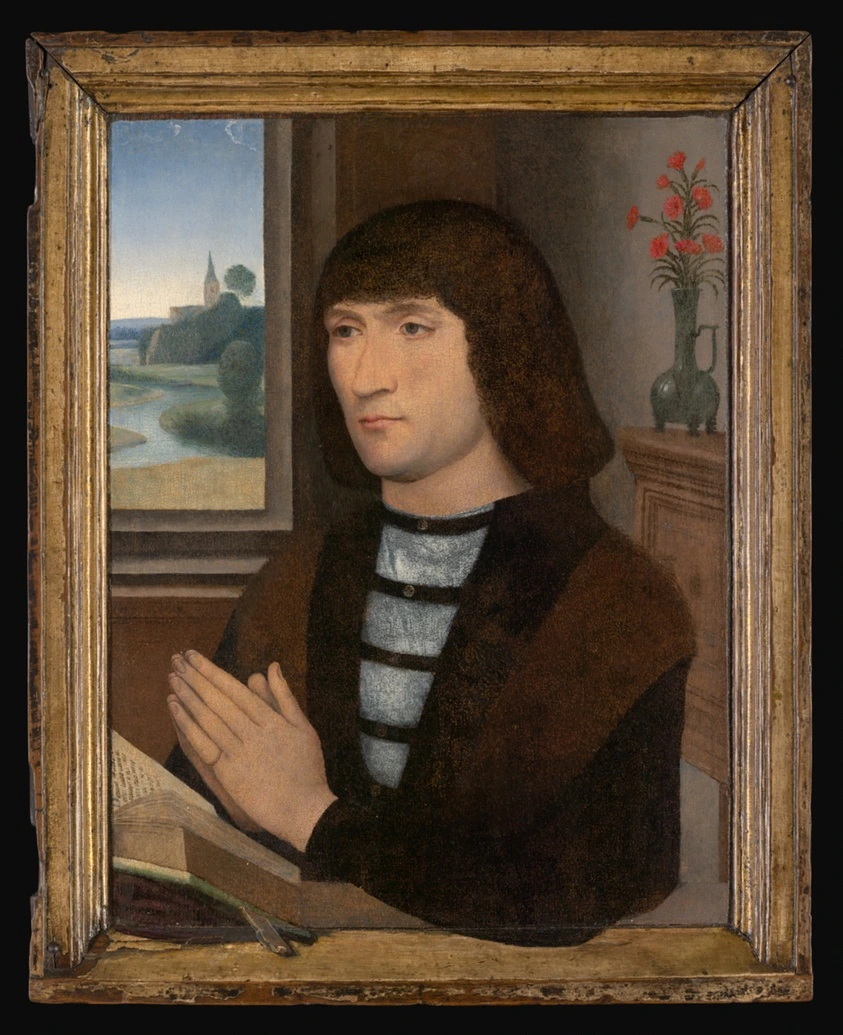
This panel and Virgin and Child once hinged together to form a diptych, with the Virgin and Child on the left and the portrait of a man facing her on the right. The condition of the portrait is very poor, while its reverse—featuring an image of Saint Anthony of Padua—is well preserved. It is painted in grisaille, a technique that mimics sculpture through monochromatic shades of beige and gray. This outer panel would have been visible when the diptych was closed and served as a transition point between the earthly setting outside the diptych into the sacred space within, painted in colorful, lavish detail. Visual cues like Anthony’s sandaled toe stepping on the edge of the frame and the reflection of two children—perhaps the donor’s—in the convex mirror behind the Virgin reinforce the paintings’ role as an intermediary meeting point reached through prayer.

Provenance

Linker, Bilbao, 1927 [Friedländer annotated a photograph now at the R.K.D., The Hague Linker / Bilbao / III 1928 / nach Restaur[ierung]]. Hugo Perls, Berlin, 1928 [according to Friedländer’s annotations to another photograph at the R.K.D., The Hague]; sold to Arthur Sachs, New York, 1929 [letter from Friedländer to Arthur Sachs, Mar. 16, 1951, and letter from Sachs to Waltraut van der Rohe, Mar. 2, 1957; both in curatorial file]; given to the Art Institute, 1953.

Portrait of a Donor (recto); Saint Anthony of Padua (verso)

Hans Memling

c. 1485

Accession Number

79777

Medium

Oil on panel

Dimensions

Framed: 41.3 × 33.3 cm (16 5/16 × 13 1/8 in.)

Classification

Painting

Museum

The Art Institute of Chicago

Chicago, United States

Credit Line

Gift of Arthur Sachs

Background & Context

Background Story

Hans Memlings Portrait of a Donor from around 1485, with a Saint Anthony of Padua on the verso, is a double-sided panel that originally formed part of a diptych or triptych, with the donors portrait on one side and a devotional image on the other. The donor, an unidentified man with the prominent nose and thin lips that characterize Memlings most psychologically acute portraits, is shown in three-quarter view against a dark background, his hands clasped in prayer and his gaze directed toward the devotional image that would have accompanied his portrait when the diptych was opened. Memling, the leading painter of Bruges in the late 15th century, developed a portrait style that combined the technical brilliance of van Eycks oil technique with a softening of contour and a warmth of modeling that gave his sitters an approachability rare in early Netherlandish portraiture. The donor is rendered with the meticulous attention to texture, from the fur lining of his robe to the individual hairs of his beard, that distinguishes Memlings best work, but the overall effect is one of psychological presence rather than mere surface description. The Saint Anthony of Padua on the verso, depicting the Franciscan saint with his attribute of the Christ Child, provided the devotional focus for the donors prayers when the panel was closed and the sacred image was visible. The portable diptych format, in which a donors portrait and a devotional image were hinged together, was a popular form of private devotion in 15th-century Flanders, allowing wealthy patrons to carry their piety with them on their travels.

Cultural Impact

Memlings donor portraits are among the most psychologically penetrating works of early Netherlandish painting, and their influence on the development of portraiture in Northern Europe extended through the 16th century. The double-sided diptych format that this panel exemplifies shaped the practice of private devotion in the Burgundian Netherlands and influenced the development of portraiture throughout Renaissance Europe.

Why It Matters

A double-sided panel by Memling with a donors portrait on the recto and Saint Anthony of Padua on the verso, combining van Eyckian technical brilliance with Memlings characteristic warmth of modeling and psychological presence in the portable diptych format of 15th-century Flemish devotion.