Provenance
Recorded as from New York. (Harry Stone Gallery, New York, 1942). (Albert Duveen, New York), by whom sold in 1948 to Edgar William and Bernice Chrysler Garbisch; by bequest to NGA, 1980.
Accession Number
1980.62.4
Medium
oil on canvas
Dimensions
overall: 55.8 x 76.5 cm (21 15/16 x 30 1/8 in.)
Classification
Painting
Credit Line
Gift of Edgar William and Bernice Chrysler Garbisch
Tags
Painting Neoclassical & Romantic (1751–1850) Oil Painting Canvas American
Background & Context
Background Story
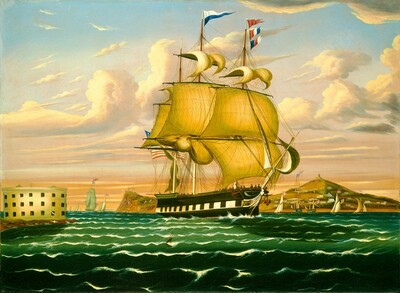
Boston Harbor (c. 1835-1845) depicts one of the most important ports in American history—the harbor that had been the site of the Boston Tea Party and that remained one of the young nation's busiest commercial centers. Chambers's treatment of Boston Harbor combines the topographical specificity that his patrons expected—the recognizable skyline, the harbor's distinctive geography, and the shipping that made Boston one of the Atlantic world's great ports—with the decorative boldness that makes his work so distinctive. The harbor, with its combination of commercial shipping, fishing vessels, and the military presence that protected American maritime commerce, provided Chambers with a subject that combined marine painting with urban documentation. The painting also captures Boston at a specific historical moment—the 1830s-1840s, when the city was transforming from a colonial port into a major industrial center, and when the harbor's commercial activity was at the heart of New England's economic growth. Chambers's characteristic palette—the bold blues, greens, and the atmospheric effects that distinguish his water surfaces—gives the Boston scene a visual intensity that more conventional marine painting of the period lacked.
Cultural Impact
Chambers's harbor paintings influenced how American urban waterfronts were represented in popular art, establishing a visual vocabulary for the harbor view that combined topographic accuracy with decorative intensity. The paintings influenced later American artists who similarly found subjects in the relationship between cities and their harbors. The Boston Harbor painting influenced how the city's maritime identity was visually constructed.
Why It Matters
This painting matters because it captures one of America's most historically significant harbors with the decorative boldness that makes Chambers's work unique in American marine painting—the combination of topographic accuracy and chromatic intensity that gives his harbor views both documentary and artistic significance.