Accession Number
8681
Medium
Watercolor and brush and black ink on off-white wove paper, laid down on off-white wove paper
Dimensions
58.7 × 73.8 cm (23 1/8 × 29 1/16 in.)
Classification
pen and ink drawings
Credit Line
Gift of Mr. John Muldoon, Jr.
Background & Context
Background Story
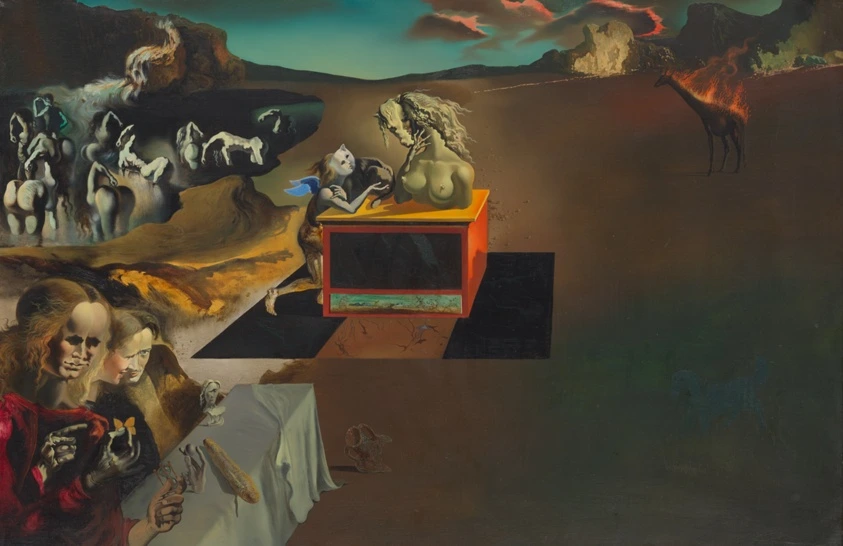
"Hidden Faces" is a c. 1944 watercolor and brush and black ink on off-white wove paper by Salvador Dalí that demonstrates the Spanish Surrealist's mastery of the double image and his exploration of the figure-ground ambiguity that characterized his most intellectually playful and visually complex works. The composition is a large work—58.7 × 73.8 centimeters—showing hidden faces within a broader composition with the watercolor and ink creating a surface of extraordinary precision and visual complexity. The double image technique creates a surface that suggests both the physical reality of the depicted scene and the hidden faces that emerge from the ambiguous forms, the technique suggesting both the playful ingenuity of the artist and the deeper psychological themes of identity and perception. The c. 1944 date places this work in the period of Dalí's growing engagement with classical techniques and his move away from the pure Surrealist automatism of his earlier work. Art historians have connected this work to the broader tradition of the double image in visual art, from the paintings of Arcimboldo to the optical illusions of the contemporary period, noting that Dalí's treatment is more focused on the psychological suggestion and the visual ingenuity, the transformation of perception into intellectual game, than the formal analysis or the aesthetic abstraction of these other traditions.
Cultural Impact
This c. 1944 watercolor ink made hidden faces perceptually playful through large 58cm double-image visual complexity and off-white paper figure-ground ambiguity, using classical-technique engagement to transform identity perception into intellectual psychological game beyond Arcimboldo formal aesthetic abstraction.
Why It Matters
It matters because Dalí painted faces hiding in faces and made the paper feel like it was playing peek-a-boo with your own brain—proving that even a picture could be a puzzle if the ink was clever enough.