Accession Number
129849
Medium
Oil on cardboard
Dimensions
49 × 64 cm (19 1/4 × 25 in.)
Classification
Painting
Credit Line
Bequest of Katharine Kuh
Background & Context
Background Story
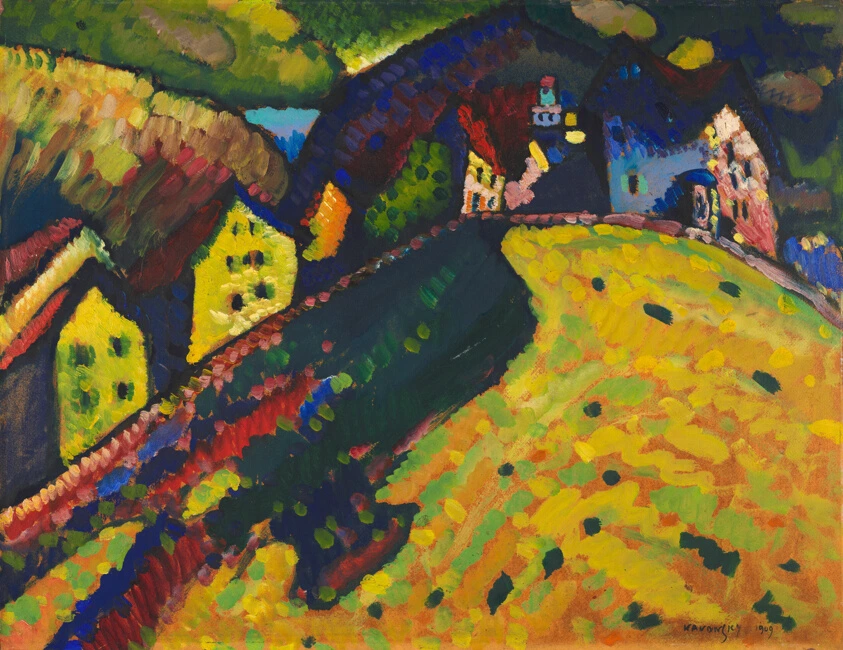
Vasily Kandinsky (1866-1944) painted Houses at Murnau in 1909, during the period when he and his companion Gabriele Munter were spending summers in Murnau, a Bavarian village where Kandinsky was developing the abstract style that would lead to his first fully abstract paintings in 1910-11. The painting depicts the houses of Murnau in the boldly colored, semi-abstract manner that Kandinsky was developing from the landscape—simplified forms, intense colors, and a flattening of perspective that shows him moving toward abstraction. The 1909 date places this just before Kandinsky's first fully abstract paintings, when the landscape was still recognizable but the intensity of color and simplification of form were pushing toward pure abstraction.
Cultural Impact
Houses at Murnau is important in the history of abstract painting because it shows Kandinsky at the crucial moment just before his first fully abstract paintings—when the landscape was still recognizable but the intensity of color and simplification of form were pushing toward pure abstraction. The 1909 painting represents the last stage of Kandinsky's journey from representational landscape to pure abstraction, and the boldly colored, semi-abstract manner of the Murnau paintings would lead directly to the first fully abstract paintings in 1910-11.
Why It Matters
Houses at Murnau is Kandinsky at the threshold of abstraction: the Bavarian village rendered in bold colors and simplified forms that show him pushing toward the first fully abstract paintings of 1910-11. The 1909 painting represents the crucial last stage of Kandinsky's journey from representational landscape to pure abstraction, still recognizable but pushing toward pure color and form.


