
Provenance
Pierre Decourcelle [1856-1926]; (sale, Hôtel Drouot, Paris, 16 June 1926, no. 73, as La Goulue et sa Soeur au Moulin-Rouge); (Galerie J. Allard); Chester Dale [1883-1962], by 1928; bequest 1963 to NGA.
Accession Number
1963.10.68
Medium
oil à l'essence on gelatin silver print mounted on board
Dimensions
Overall: 47.4 x 36.5 cm (18 11/16 x 14 3/8 in.) | framed: 66 x 55.2 cm (26 x 21 3/4 in.)
Classification
Drawing
Credit Line
Chester Dale Collection
Tags
Drawing Impressionist & Modern (1851–1900) Oil Painting Board French Color: Brown
Background & Context
Background Story
La Goulue and Her Sister (c. 1892) depicts the most famous cancan dancer of Montmartre—La Goulue (The Glutton), born Louise Weber—with her sister, capturing the dance-hall world that was Toulouse-Lautrec's primary subject. La Goulue, who had risen from a laundress's daughter to become the star of the Moulin Rouge, embodied the social mobility that Montmartre's entertainment world made possible. Toulouse-Lautrec's 1892 painting of La Goulue and her sister captures the performer off-stage—in a domestic or backstage moment that reveals the person behind the persona. The sisters' pairing creates a visual contrast between the public and private self: La Goulue the performer and the sister who shared her private life. This distinction between public persona and private reality was central to Toulouse-Lautrec's art—he consistently revealed the human dimension of performance that theatrical representations typically concealed. The 1892 date places this during Toulouse-Lautrec's most productive Montmartre period, when he was painting and making lithographs of the dance halls, circuses, and brothels that formed his artistic world. His treatment of La Goulue demonstrates his characteristic method: the figure is rendered with the sinuous line and simplified forms that distinguished his work from more conventional figure painting, capturing the performer's essential character with an economy that portraiture rarely achieved.
Cultural Impact
Toulouse-Lautrec's La Goulue paintings influenced how the Montmartre entertainment world was represented in art, establishing the offstage perspective that revealed performers' private dimensions. The paintings influenced later artists who similarly depicted the personal lives of public performers—from the Weimar Republic's Neue Sachlichkeit to contemporary celebrity photography. La Goulue herself influenced how cancan culture was understood, connecting the dance's public spectacle to the individual performer's private experience.
Why It Matters
This painting matters because it reveals the person behind the most famous performer of Montmartre—the sister alongside La Goulue argues that the private self persists regardless of public performance, and that art's deepest function is to reveal this persistence rather than to record the spectacular surface that audiences pay to see.
Related Artworks
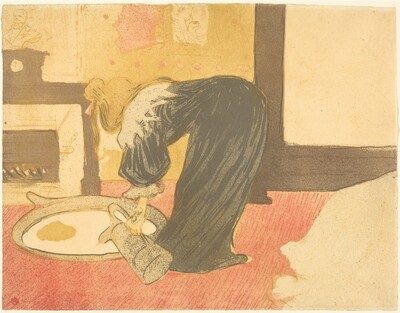
Woman at the Tub (Femme au tub)
Toulouse-Lautrec, Henri de

Guy and Mealy in "Paris qui marche" (Guy et Mealy dans "Paris qui marche")
Toulouse-Lautrec, Henri de
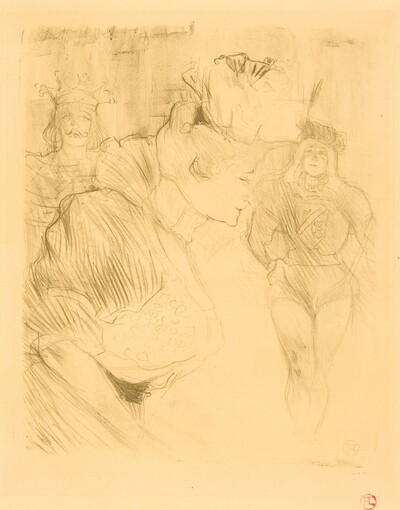
Lender Bowing (Lender saluant)
Toulouse-Lautrec, Henri de

Rejane and Galipaux in "Madame Sans-Gêne" (Réjane et Galipaux dans "Madame Sans-Gêne")
Toulouse-Lautrec, Henri de