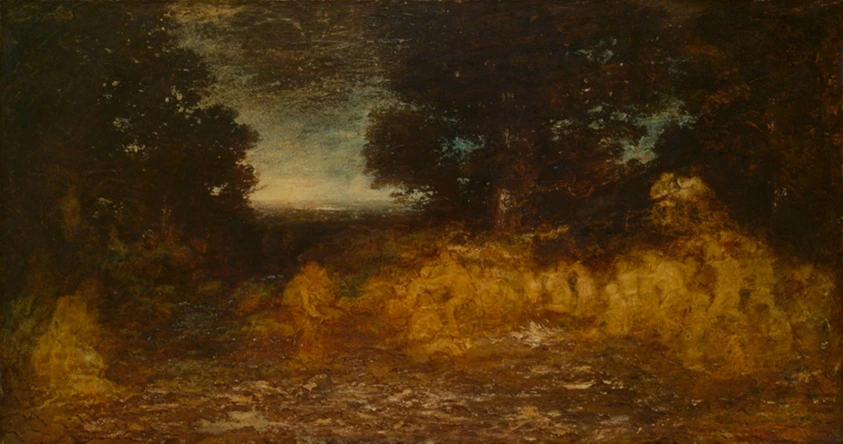
Ghost Dance (The Vision of Life)

Description

The Ghost Dance, or “Messiah Craze” as the press called it, fused elements of Native American religions and Christianity to express ideas about the resurrection and rejuvenation of indigenous cultures. An assertion of Native American pride and empowerment in the late 1880s, these ceremonies drew the attention of ethnographers and aroused the suspicions of United States government and military officials. After the murders of Big Foot and Sitting Bull and the massacre at Wounded Knee in 1890, the Ghost Dance became part of the mythology of the vanishing Indian. In Ralph Blakelock’s murky, deliberately ambiguous composition, the dancing figures appear as ghosts or shadows—insubstantial fragments of a memory or a dream. Indeed, the artist's understanding of such performances was drawn from accounts in newspapers and magazines. He had not traveled to the West since the early 1870s, more than 20 years before painting this work.

Provenance

Ralph Albert Blakelock and Cora Bailey Blakelock (1857–1950); sold to William S. Hurley, New York and Brooklyn, NY, by 1909 [“Masterpiece by Blakelock to Be Sold by Anderson Galleries,” American Art News 20, no. 21 (Mar. 4, 1922), 6; Seattle 1909, cat. 358]; Moulton & Ricketts, Chicago, about 1911 [American Art News 20, no. 21 (Mar. 4, 1922), 6]; Charles P. Pinckard (1864–1920), Chicago, by Oct. 1912 [James William Pattison, “The Art of Blakelock,” Fine Arts Journal 27, no. 4 (Oct. 1912), 641]. Joseph G. Snydacker (1865–1920), Chicago, by Dec. 1913 [Elliott Daingerfield, “Ralph Albert Blakelock,” Art in America 2 (Dec. 1913), 57]; sold at Anderson Galleries, NY, to Charles H. Worcester (1864–1956) and Mary F. S. Worcester (1861–1954), Chicago, through John Levy Galleries, NY, and Woodruff J. Parker (agent), 1922 [“49 Paintings Bring $72,647 at Auction,” American Art News, Mar. 25, 1922, 1]; given to the Art Institute of Chicago, 1947.

Ghost Dance (The Vision of Life)

Ralph Albert Blakelock

1895–97

Accession Number

90062

Medium

Oil on canvas

Dimensions

53.7 × 100 cm (21 1/8 × 39 3/8 in.)

Classification

Painting

Museum

The Art Institute of Chicago

Chicago, United States

Credit Line

Charles H. and Mary F. S. Worcester Collection
Background & Context

Background Story

Ralph Albert Blakelocks Ghost Dance (The Vision of Life) from 1895-97 is an oil painting that exemplifies the American landscape painters visionary approach to the nocturnal landscape, in which the natural world is transformed into a dreamlike realm of mysterious light and ambiguous space. Blakelock, who spent years painting moonlit landscapes that sold for modest prices while he descended into poverty and mental illness, produced a body of work that is remarkable for its atmospheric intensity and its ability to suggest psychological states through the manipulation of light, color, and space. The title Ghost Dance refers to the Native American religious movement of the late 19th century, in which practitioners believed that through ritual dance they could communicate with the spirits of the dead and bring about the restoration of their traditional way of life. Blakelock, who was fascinated by Native American culture and had lived among various tribes, may have intended the painting as a depiction of a Ghost Dance ceremony, or the title may refer more generally to the visionary quality of the landscape itself, in which the moonlit forms of trees and terrain seem to dissolve into the ghostly light that emanates from within the painting. The oil on canvas medium, applied in the thick impasto and dark glazes that distinguish Blakelocks best work, creates a surface that appears to absorb and emit light simultaneously, giving the nocturnal landscape a luminosity that transcends the conventional limitations of moonlight painting.

Cultural Impact

Blakelocks nocturnal landscapes are among the most original works in American painting, and their influence on the development of Tonalism, Symbolism, and the broader tradition of visionary landscape extends through the 20th century. Ghost Dance influenced the development of American landscape painting as a vehicle for psychological expression.

Why It Matters

An oil painting by Blakelock from 1895-97 titled Ghost Dance, transforming the nocturnal landscape into a visionary realm of mysterious light and ambiguous space through thick impasto and dark glazes that suggest both the Native American religious ceremony and psychological visionary states.