Description
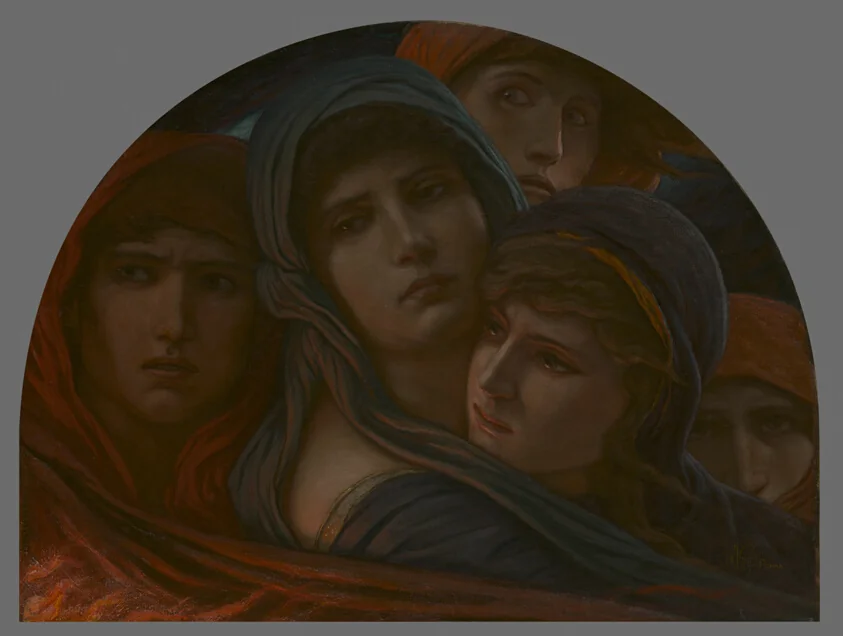
Elihu Vedder probed questions of the mind in his paintings and illustrations, creating complex, visionary compositions often centered on literary or spiritual subject matter. The lunette A Glimpse into Hell, or Fear is drawn from 14th-century poet Dante Alighieri’s Inferno, the first part of his epic poem, Divine Comedy. Here, five females confront the gate of Hell. Beholding such a sight, they express apprehension and fear, accentuated by the swirling forms of their draperies and hair. Vedder focused on the figures’ psychological tension, rather than the spectacle of the environs itself, depicting only a sliver of fiery flames at bottom left.
Accession Number
97884
Medium
Oil on canvas
Dimensions
40 × 52.4 cm (15 3/4 × 20 5/8 in.)
Classification
Painting
Credit Line
George F. Harding Collection
Background & Context
Background Story
"A Glimpse into Hell, or Fear" is an 1888–98 oil on canvas by Elihu Vedder that captures the American Symbolist at his most psychologically penetrating, the image exploring the darkest dimensions of human experience through the vocabulary of visionary fantasy that Vedder had developed over decades of engagement with mythology, literature, and esoteric philosophy. The composition shows a figure—probably a woman or a child—peering into a dark opening or abyss, the face illuminated by a pale, unearthly light that suggests both the terror of the unknown and the morbid curiosity that draws the observer toward destruction. The palette is dark and muted—browns, blacks, and sickly greens that create an atmosphere of claustrophobia and dread, the small scale of the canvas intensifying the sense of intimacy and entrapment. The 1888–98 date indicates a long period of execution, suggesting that Vedder returned to this disturbing image over many years, the painting becoming an obsession that he could not complete or abandon, the prolonged engagement reflecting the depth of the psychological material it explores. Art historians have connected this painting to the broader tradition of the hellscape in Western art, from the tormented figures of Bosch to the demonic visions of Blake, noting that Vedder's treatment is more intimate, more focused on the individual experience of fear than the collective damnation of these predecessors. The work also reflects Vedder's engagement with the darker aspects of the Symbolist movement: the fascination with death, decay, and the irrational that characterized the art and literature of the fin de siècle finds powerful expression in this small but devastating canvas.
Cultural Impact
This 1888–98 oil canvas made individual fear claustrophobic through decade-long obsessive dark execution, using sickly green-brown dread and small-scale intimacy to transform Symbolist hellscape into private psychological abyss.
Why It Matters
It matters because Vedder painted a glimpse of hell and made it look like something inside your own mind—proving that even the darkest vision could be personal if the scale was small enough.


