Accession Number
17217
Medium
Drypoint and open bite etching in black on off-white wove plate paper
Dimensions
Image: 26.7 × 19.3 cm (10 9/16 × 7 5/8 in.); Plate: 28.6 × 21 cm (11 5/16 × 8 5/16 in.); Sheet: 42.9 × 34.2 cm (16 15/16 × 13 1/2 in.)
Classification
etching
Credit Line
Clarence Buckingham Collection
Background & Context
Background Story
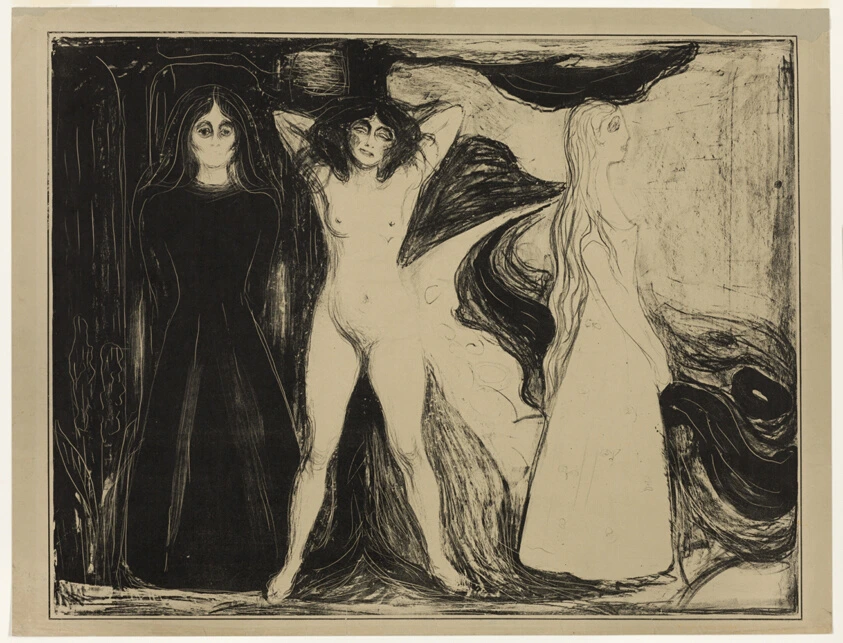
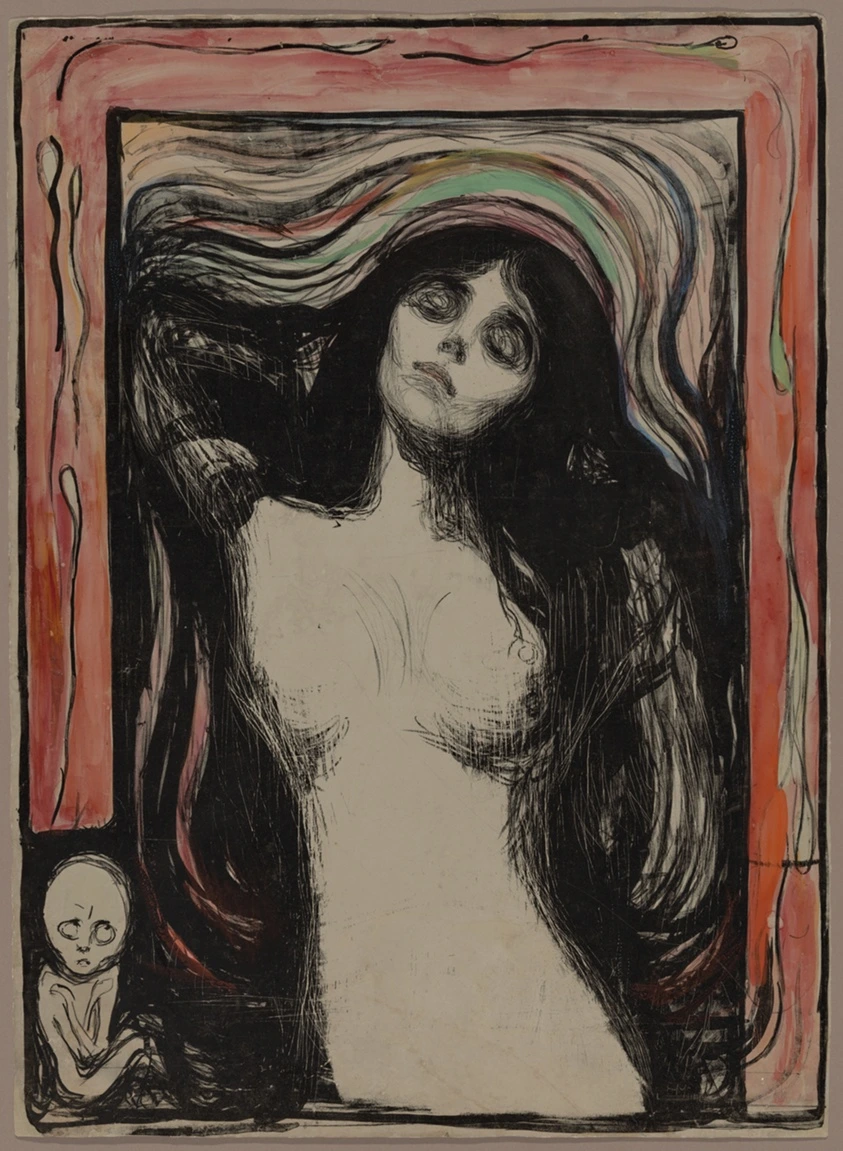
"Study of a Model" is an extraordinary drypoint and open-bite etching from 1894, belonging to the period when Edvard Munch was exploring printmaking as a medium for psychological investigation, using the acid-bitten plate to express what painting could not quite capture. The image shows a female nude rendered with the velvety blacks of drypoint burr and the granular tones of open-bite, creating a figure that seems to emerge from darkness rather than being modeled by light. The subject's identity is uncertain—possibly one of the many lovers and models who circulated through Munch's bohemian circle in Berlin and Paris—but the treatment transcends portraiture to become an exploration of female presence as mystery. The drypoint technique is crucial: the burr raised by the scratching needle holds ink in soft accumulations that create tonal gradations unlike the sharp clarity of pure etching. Munch's use of open-bite—leaving areas of the plate exposed to acid for extended periods—produces granular, atmospheric backgrounds that suggest psychological space rather than physical settings. This combination of techniques was largely Munch's invention; previous printmakers had not exploited the expressive possibilities of mixed intaglio with such systematic intention. The work also reflects Munch's engagement with Symbolist aesthetics: the female body is not an object of desire but a source of anxiety, the darkness surrounding it suggesting the unconscious fears that Freud was simultaneously theorizing in Vienna. In the history of printmaking, this etching established that the medium could convey the same emotional intensity as oil painting when handled by a master.
Cultural Impact
This mixed-intaglio etching invented a language of psychological darkness through drypoint burr and open-bite, establishing printmaking as an equal medium for Symbolist anxiety alongside oil painting.
Why It Matters
It matters because Munch made a woman out of ink and fear—proving that a plate of scraped metal could hold as much trembling as any painted canvas.