Accession Number
55739
Medium
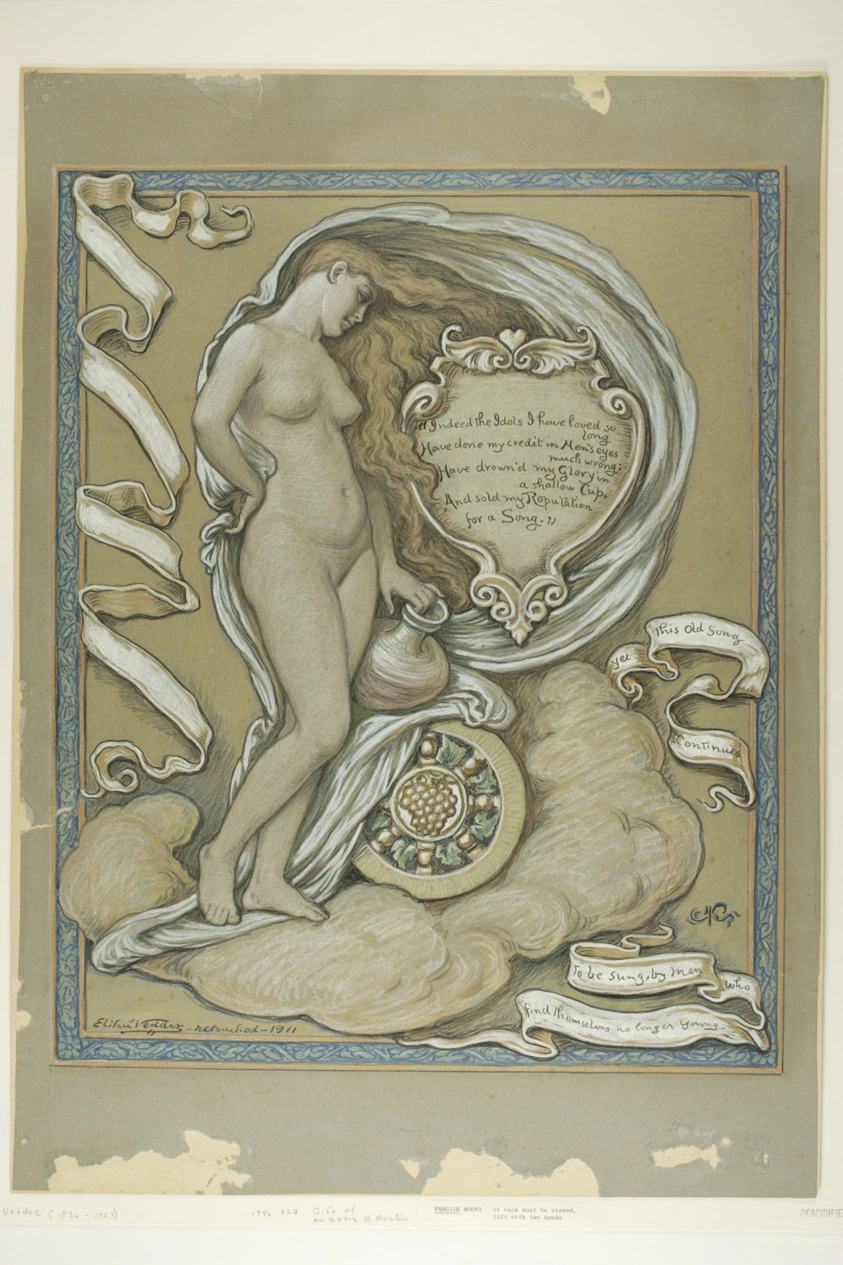
Black wax crayon and a variety of colored wax crayons with graphite and touches of gold pigment, heightened with white gouache on blue wove paper (discolored) laid down on tan board
Dimensions
64.9 × 46.6 cm (25 9/16 × 18 3/8 in.)
Classification
crayon
Credit Line
Gift of Mrs. Horace H. Martin
Background & Context
Background Story
Elihu Vedders Figure Study for Rubaiyat of Omar Khayyam from around 1884, reworked in 1911, is a crayon drawing that belongs to the artists most famous project: his illustrated edition of Edward FitzGeralds translation of the Rubaiyat, published in 1884 by Houghton Mifflin and destined to become the most commercially successful artist book in American publishing history. Vedder spent four years designing the illustrations, and this figure study belongs to the preparatory process, a working drawing in which the artist explores poses and compositions using the novel combination of black and colored wax crayons with graphite, gold pigment, and white gouache on blue paper. The multiplicity of media reflects the complexity of Vedders creative process: the black crayon establishes the primary contours, the colored crayons test the chromatic scheme, the gold pigment adds the mystical accent that distinguishes Vedders Rubaiyat from conventional illustration, and the white gouache provides highlights that make the figure emerge from the blue ground like a vision from a dream. The fact that Vedder reworked the drawing in 1911, nearly three decades after the Rubaiyats publication, suggests that he regarded the project not as a completed commission but as an ongoing meditation on the quatrains that had come to define his artistic identity. The blue paper, now discolored, originally provided a ground that suggested both the night sky and the mystical atmosphere of the poem.
Cultural Impact
Vedders Rubaiyat illustrations were the most successful American artist book of the 19th century and defined the visual interpretation of FitzGeralds poem for generations of readers. The preparatory drawings reveal the technical experimentation and mystical aspiration that lay behind the finished illustrations, and their influence on Art Nouveau illustration and the broader culture of artist-designed books extends to the present day.
Why It Matters
A preparatory figure study by Vedder for his Rubaiyat illustrations, combining wax crayons, graphite, gold pigment, and gouache on blue paper to explore mystical imagery, and later reworked in 1911 as an ongoing meditation on the poem that defined his career.


