
Description
This print centers on two wounded soldiers as they return from the disastrous French invasion of Russia. In 1812 the French army, led by Napoleon, fought its way into Russian territory, beginning a bloody campaign that lasted five months and ended in a decisive loss for the French that decimated the size of the force as well as public faith in the French military.
Accession Number
75089
Medium
Lithograph in black with tan tint stone on ivory wove paper
Dimensions
Image: 44.4 × 36.1 cm (17 1/2 × 14 1/4 in.); Sheet: 58.7 × 41.9 cm (23 1/8 × 16 1/2 in.)
Classification
lithograph
Credit Line
Albert H. Wolf Memorial Collection
Background & Context
Background Story
"The Return from Russia" is an 1818 lithograph by Théodore Géricault that captures the French Romantic painter at the beginning of his graphic career, the image showing the disastrous retreat of Napoleon's army from Moscow with the same dramatic intensity that Géricault would bring to his masterpiece "The Raft of the Medusa" only two years later. The composition shows soldiers and stragglers struggling through the Russian winter, the figures rendered with the bold, expressive strokes of lithography that suggest both the physical suffering of the retreat and the psychological horror of defeat. The tan tint stone adds a sepia warmth that makes the image feel like a historical document, the color suggesting the faded grandeur of the Napoleonic epic and the human cost of imperial ambition. The 1818 date places this work in the period of Géricault's first major successes as a printmaker, when he was producing lithographs that established his reputation as the leading Romantic graphic artist in France. Art historians have compared this print to the painted "Raft of the Medusa" and the other disaster scenes that made Géricault famous, noting that the lithographic medium allows for a more rapid, more spontaneous treatment than the large canvases, the smaller scale creating an intimacy that intensifies the emotional impact. The work also demonstrates Géricault's political engagement: the critique of Napoleonic ambition that is implicit in the image of the defeated army reflects the artist's complex relationship with the Bonapartist legacy and his sympathy for the common soldier.
Cultural Impact
This 1818 lithograph made Napoleonic retreat intimately horrific through bold expressive strokes and sepia tint warmth, using smaller-scale spontaneity to intensify common-soldier suffering before the Medusa masterpiece.
Why It Matters
It matters because Géricault drew an army coming home in defeat and made the snow look like it was eating them—proving that even failure could be grand if the lithograph was honest enough.
Related Artworks

Head of a Guillotined Man
Jean Louis André Théodore Géricault
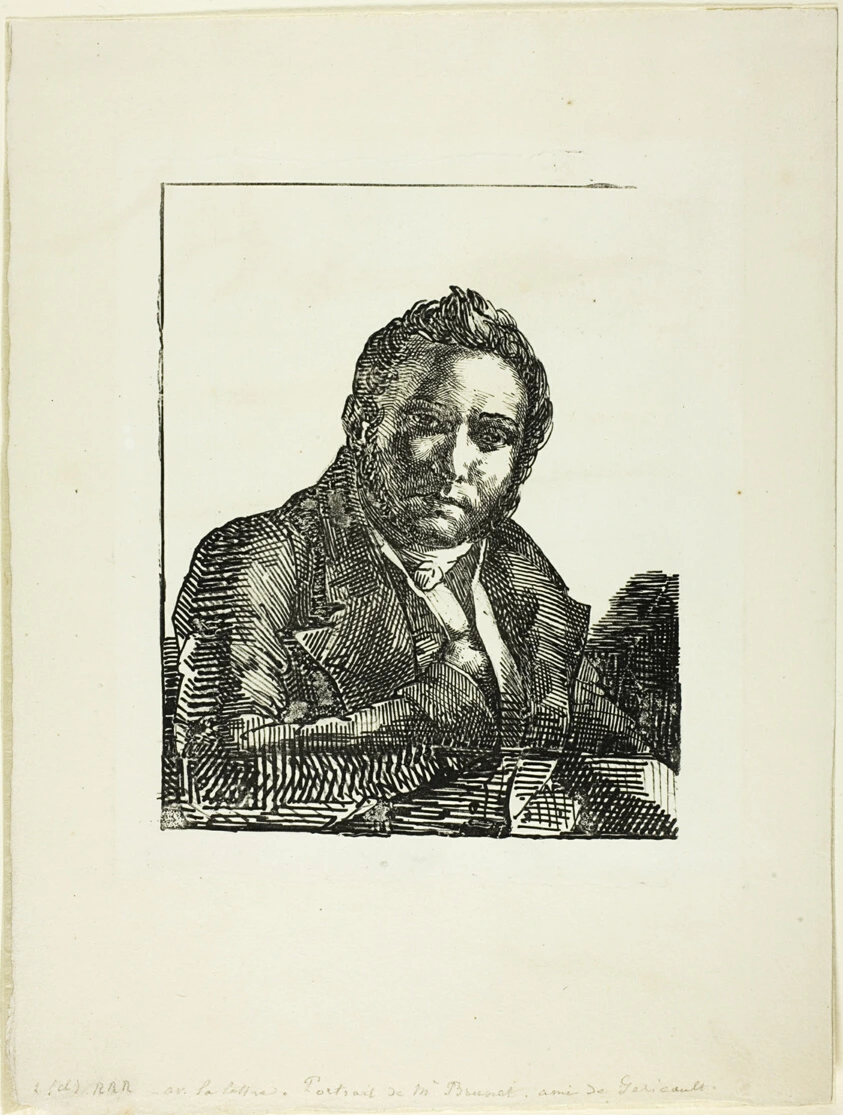
Portrait of Auguste Brunet
Jean Louis André Théodore Géricault

Horses Going to a Fair, plate 3 from Various Subjects Drawn from Life on Stone
Jean Louis André Théodore Géricault

A Party of Life Guards, plate 5 from Various Subjects Drawn from Life on Stone
Jean Louis André Théodore Géricault