Accession Number
98149
Medium
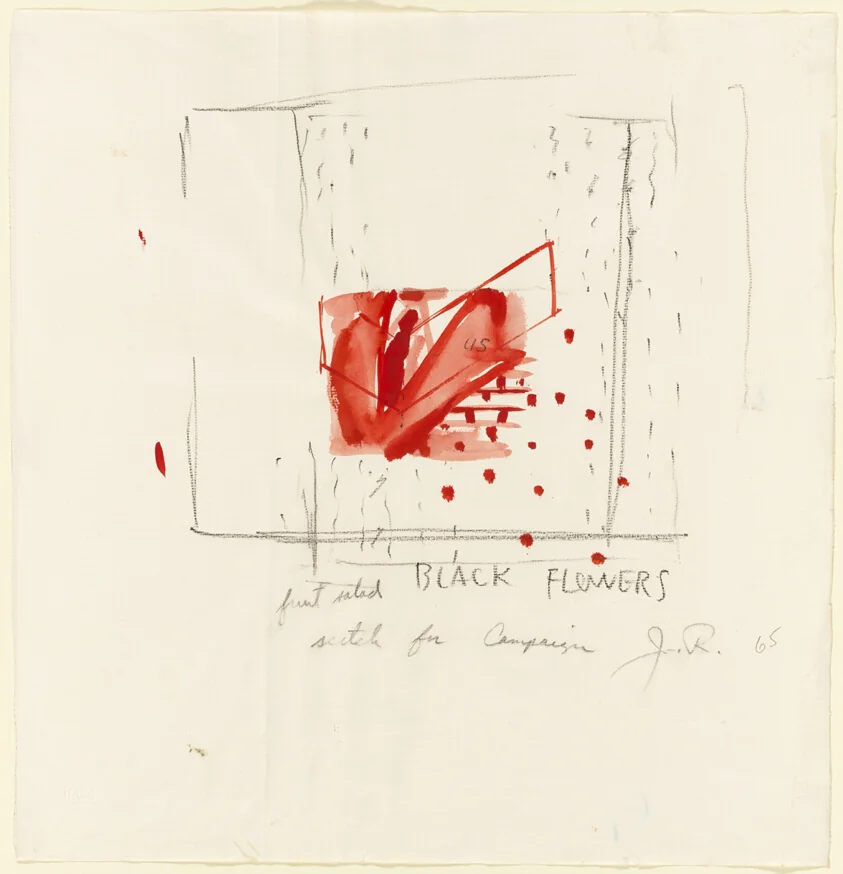
Watercolor in red and black lithographic crayon on white laid paper
Dimensions
48.3 × 47 cm (19 1/16 × 18 9/16 in.)
Classification
watercolor
Credit Line
U.L.A.E. Collection acquired through a challenge grant of Mr. and Mrs. Thomas Dittmer; purchased with funds provided by supporters of the Department of Prints and Drawings; Centennial Endowment; Margaret Fisher Endowment Fund
Background & Context
Background Story
"Campaign" is a 1965 watercolor and lithographic crayon drawing by James Rosenquist that captures the American Pop artist at the height of his billboard-painting powers, the image showing the graphic vocabulary of advertising and political propaganda translated into the intimate scale and fluid medium of the artist's studio. The composition is a field of red and black marks, the lithographic crayon creating bold, graphic strokes that suggest both the typography of political posters and the abstract shapes of commercial design, the watercolor adding tonal variation and atmospheric depth that makes the image feel both immediate and mysterious. The white laid paper provides a textured ground that catches the crayon and watercolor in different ways, creating a surface of extraordinary visual interest that suggests both the rough texture of billboard paper and the refined surface of fine art. The 1965 date places this work in the period of Rosenquist's most intensive painting activity, when he was producing the large-scale works like "F-111" that established his reputation as the leading Pop painter of the narrative billboard tradition. Art historians have connected this drawing to the broader tradition of political imagery in American art, from the propaganda posters of the World Wars to the campaign imagery of the 1960s, noting that Rosenquist's treatment is more abstract, more focused on the visual language of advertising than the specific political message of these other traditions. The work also demonstrates the range of Rosenquist's draftsmanship: from the monumental paintings to the intimate drawings, the same graphic energy and commercial vocabulary inform every level of his practice.
Cultural Impact
This 1965 watercolor-crayon drawing translated billboard propaganda into intimate studio fluidity, using red-black graphic strokes and textured laid-paper surface to make political advertising vocabulary simultaneously immediate and mysteriously abstract.
Why It Matters
It matters because Rosenquist drew a campaign and made the crayon feel like it was shouting from a poster—proving that even politics could be beautiful if the red was bold enough.


