Accession Number
98160
Medium
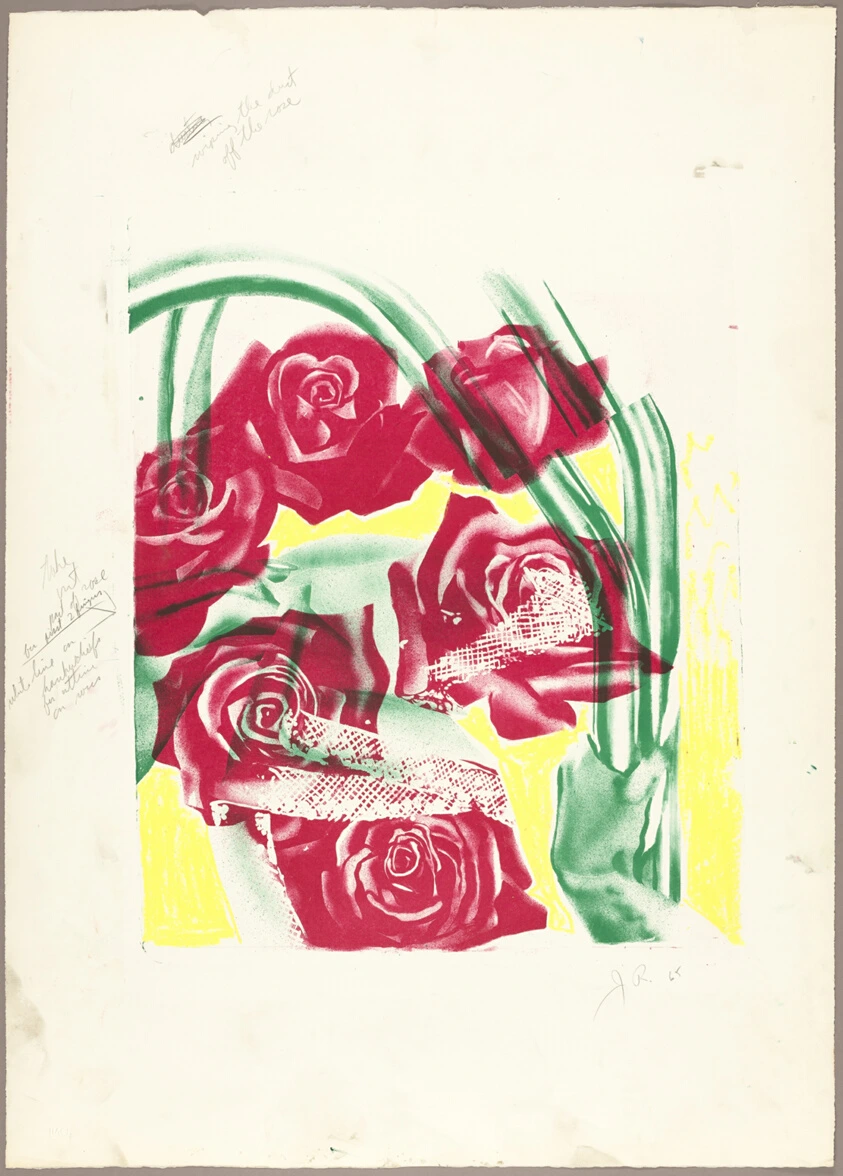
Lithograph in red and green, with yellow pastel additions, on white wove paper
Dimensions
105.4 × 75.7 cm (41 1/2 × 29 13/16 in.)
Classification
lithograph
Credit Line
U.L.A.E. Collection acquired through a challenge grant of Mr. and Mrs. Thomas Dittmer; purchased with funds provided by supporters of the Department of Prints and Drawings; Centennial Endowment; Margaret Fisher Endowment Fund
Background & Context
Background Story
"Dusting Off Roses" is a 1965 lithograph by James Rosenquist that belongs to the series of prints in which the American Pop artist explored the transformation of commercial imagery into poetic metaphor, the image showing roses being dusted or cleaned with the same graphic vocabulary that Rosenquist employed in his billboard paintings, the flowers becoming symbols of both beauty and consumer maintenance. The composition is a large, horizontal format—105.4 × 75.7 centimeters—that suggests the scale of a billboard or a magazine spread, the lithographic technique creating bold, flat areas of color that mimic the visual impact of commercial printing while the pastel additions introduce a hand-drawn quality that suggests the artist's personal intervention. The red and green colors create a complementary contrast that makes the roses appear vibrant and artificial, the colors of advertising rather than nature, the flowers becoming signs or commodities rather than organic life. The 1965 date places this work in the same year as "Campaign" and the other early prints, suggesting that Rosenquist was systematically exploring the possibilities of the print medium as a vehicle for his billboard aesthetic. Art historians have connected this print to the broader tradition of the flower image in modern art, from the water lilies of Monet to the flower paintings of Warhol, noting that Rosenquist's treatment is more focused on the process of commercial maintenance, the dusting and cleaning that keeps the image fresh, than the aesthetic contemplation or the mass production of these predecessors.
Cultural Impact
This 1965 lithograph made flower-maintenance commercially poetic through large-format complementary red-green billboard flatness, using pastel hand-drawn intervention to transform rose beauty into consumer-dust commodity signs.
Why It Matters
It matters because Rosenquist drew roses being dusted and made the paper feel like it was cleaning itself—proving that even a flower could be an advertisement if the colors were bright enough.


