Accession Number
98159
Medium
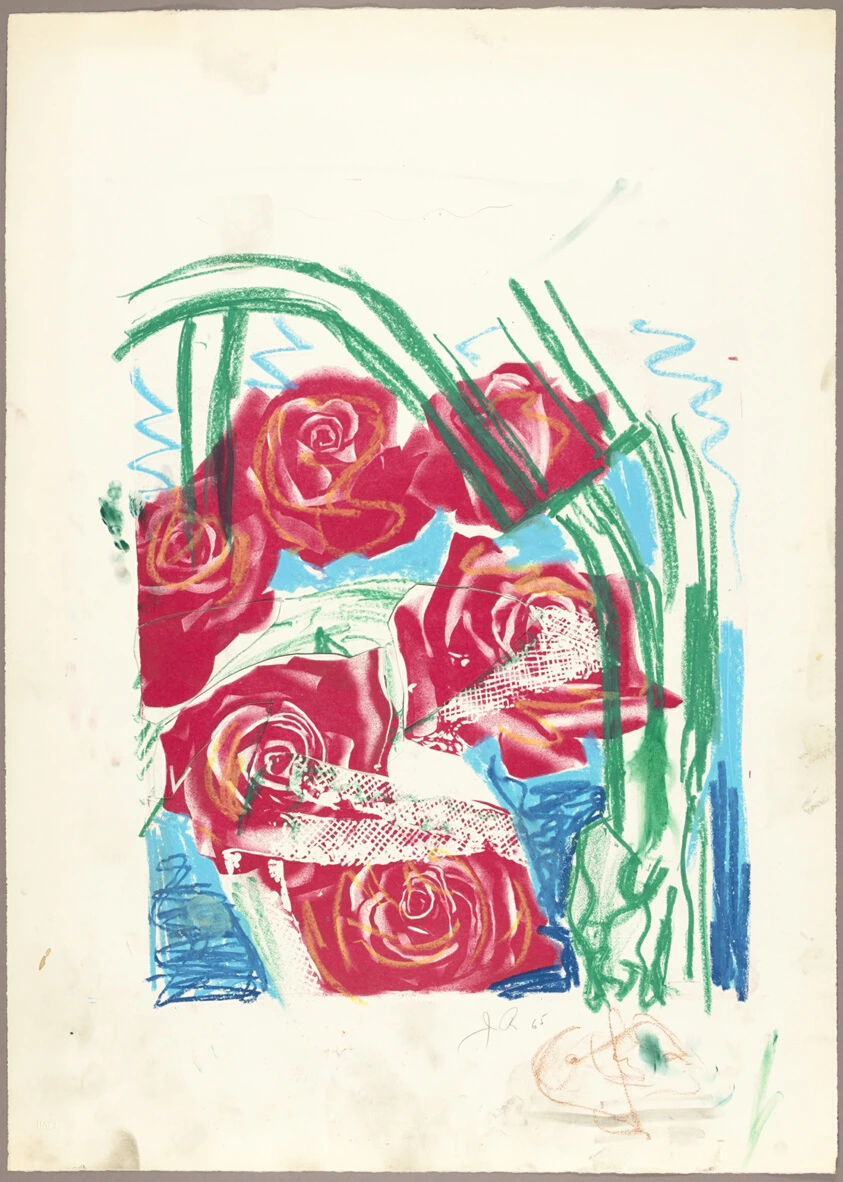
Lithograph in red, with blue, green and brown pastel additions and cutouts, on white wove paper
Dimensions
105.9 × 75.4 cm (41 3/4 × 29 11/16 in.)
Classification
lithograph
Credit Line
U.L.A.E. Collection acquired through a challenge grant of Mr. and Mrs. Thomas Dittmer; purchased with funds provided by supporters of the Department of Prints and Drawings; Centennial Endowment; Margaret Fisher Endowment Fund
Background & Context
Background Story
James Rosenquists Dusting Off Roses from 1965 is a lithograph in red with pastel additions and cutouts that exemplifies the Pop artists approach to printmaking as an extension of painting, combining the mechanical reproduction of lithography with the hand-applied additions and physical interventions that blur the boundary between print and unique artwork. The red lithographic ground, which covers the sheet with a field of saturated color, is a typical Rosenquist strategy of using printing as a means of establishing a chromatic foundation that the hand additions then modify and enrich. The blue, green, and brown pastel additions are applied directly to the printed surface, creating a layering of mechanical and manual marks that reflects Rosenquists artistic practice of combining commercial imagery with hand-painted interpretation. The cutouts, physical holes in the paper that reveal the wall or backing board behind the print, are the most radical intervention, transforming the print from a two-dimensional image into a three-dimensional object that incorporates the real space of the gallery into the visual experience of the work. The year 1965 places this print in the early phase of Rosenquists career, when he was establishing the approach to combining commercial imagery, monumental scale, and physical intervention that would define his contribution to Pop Art and distinguish his work from the more documentary approaches of Warhol and Lichtenstein.
Cultural Impact
Rosenquists prints with pastel additions and cutouts represent a significant expansion of the possibilities of printmaking in the 1960s, demonstrating that prints could incorporate the same physical interventions and painterly additions as paintings. Dusting Off Roses influenced the development of experimental printmaking and the blurring of boundaries between print and unique artwork that characterized the print renaissance of the 1960s and 1970s.
Why It Matters
A red lithograph by Rosenquist with pastel additions and physical cutouts that blurs the boundary between print and painting, combining mechanical reproduction with hand-applied additions and spatial interventions that characterize his Pop Art approach to printmaking.


