
Provenance
Jean-Jacques-Nicolas Montcimet de Musigny (died 1843); sold, Paris, March 7-8, 1845, lot 59 [according to Bazin 1994]. Baron (Ferdinand?) Hamelin, by 1924 [Paris 1924]. Sold, Paris, May 15, 1950, to Pierre Dubaut (died 1968), Paris [according to New York 1986]; Pierre Dubaut, to at least 1957 [Paris 1957]. Sold by Walter Goetz, New York, to the Art Institute, 1960.
General of the First Empire Giving his Cavalry Orders to Charge
n.d.
Accession Number
111114
Medium
Watercolor, with red chalk and graphite, on cream wove paper, laid down on cream board
Dimensions
53.5 × 45 cm (21 1/8 × 17 3/4 in.)
Classification
watercolor
Credit Line
Ada Turnbull Hertle Fund
Background & Context
Background Story
This watercolor by Théodore Géricault showing a general of the First Empire giving cavalry orders captures the French Romantic painter's lifelong fascination with military life and heroic command, the image rendered in watercolor with red chalk and graphite on cream wove paper with a fluidity and immediacy that suggests both the urgency of battle and the artist's rapid observation. The composition shows the general on horseback, his arm raised in command, the cavalry ready to charge, the scene rendered with the muscular energy and dramatic lighting that Géricault brought to all his military subjects. The watercolor technique allows for the tonal gradations that suggest the dust and smoke of the battlefield, the red chalk adding accents that pick out the uniforms and the flags, the graphite providing the structural framework that keeps the composition coherent despite the fluidity of the medium. The undated sheet probably belongs to the period of Géricault's most intensive military studies, the 1810s and 1820s when he was producing paintings, drawings, and prints that documented the Napoleonic era with a combination of admiration and critical distance. Art historians have connected this drawing to the broader tradition of military imagery in French art, from the heroic equestrian portraits of David to the critical battle scenes of the Realists, noting that Géricault's treatment combines the grandeur of the former with the humanity of the latter, the general presented as a heroic figure but the scene suggesting the cost of his command.
Cultural Impact
This watercolor captured Napoleonic cavalry command with rapid muscular immediacy, using red-chalk uniform accents and graphite structural discipline to combine heroic grandeur with human battle-cost awareness.
Why It Matters
It matters because Géricault drew a general giving an order and made the paper feel like it was about to charge—proving that even a sketch could have thunder if the arm was raised high enough.
Related Artworks

Head of a Guillotined Man
Jean Louis André Théodore Géricault
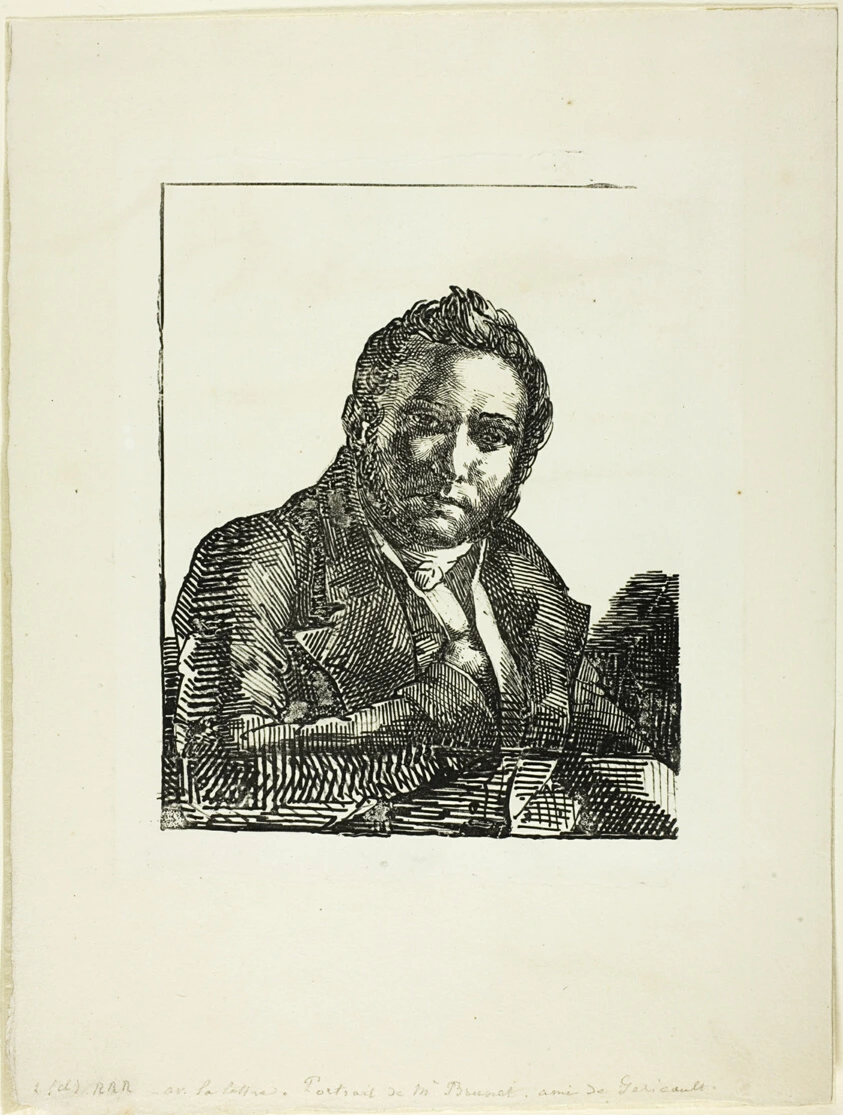
Portrait of Auguste Brunet
Jean Louis André Théodore Géricault

Horses Going to a Fair, plate 3 from Various Subjects Drawn from Life on Stone
Jean Louis André Théodore Géricault

A Party of Life Guards, plate 5 from Various Subjects Drawn from Life on Stone
Jean Louis André Théodore Géricault