Accession Number
1943.3.1286
Medium
watercolor and pen and ink, pinpricked around perimeter
Dimensions
overall (approximate): 29.5 x 54.3 cm (11 5/8 x 21 3/8 in.)
Classification
Drawing
Credit Line
Rosenwald Collection
Tags
Drawing Impressionist & Modern (1851–1900) Watercolor Ink British
Background & Context
Background Story
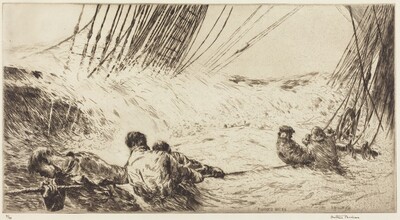
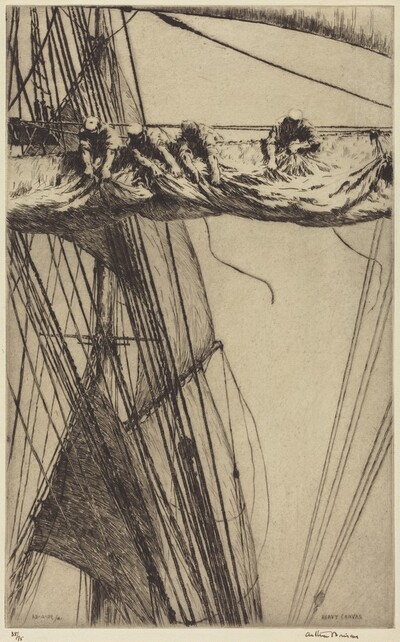
The N.E. Trades — the northeast trade winds that blow steadily in the tropics — were every sailing ship's reliable engine, and Briscoe's drawing captures the conditions they create: steady wind, manageable seas, and the ship running before it with sails set and drawing. The unusual technique of pinpricking around the perimeter suggests this watercolor was intended for reproduction (the pinpricks align the paper for photographic transfer), connecting it to Briscoe's parallel career as an illustrator. The combination of watercolor and pen and ink is characteristic of his most finished works, combining the atmospheric effects of watercolor with the structural precision of line.
Cultural Impact
Briscoe's documentation of sailing ship operations — tacking, wearing, reefing, and running before the trades — was unmatched in British art. His drawings serve as technical records of working sail as well as artistic achievements, and the pinpricked perimeter of this drawing suggests it was intended for publication, making it part of his mission to record the dying age of sail for a wider audience.
Why It Matters
In the N.E. Trades is Briscoe documenting the most reliable wind in a sailor's world. The steady running conditions, the set sails, and the manageable seas are all recorded with the precision of a man who has steered a ship through these conditions himself — and the pinpricked perimeter tells us he intended this knowledge to reach an audience beyond the maritime community.