Accession Number
1943.3.1287
Medium
watercolor and charcoal
Dimensions
overall: 25.5 x 35.9 cm (10 1/16 x 14 1/8 in.)
Classification
Drawing
Credit Line
Rosenwald Collection
Tags
Drawing Early Modern (1901–1950) Watercolor Charcoal British
Background & Context
Background Story
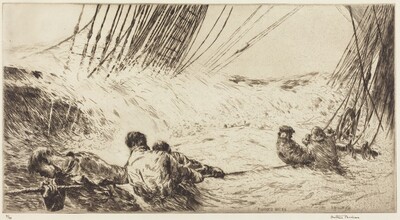
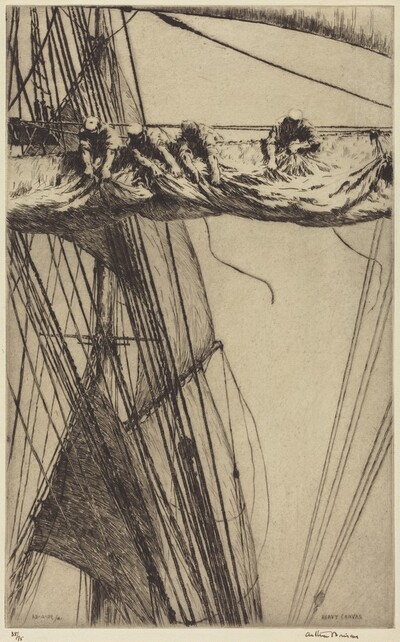
Gravesend, at the mouth of the Thames, was the last port of call for ships leaving London and the first landfall for vessels arriving. Briscoe's 1915 watercolor and charcoal drawing captures the working waterfront at a moment of particular historical significance: the early years of World War I, when the Thames estuary was a strategic waterway congested with naval and commercial traffic. The combination of watercolor and charcoal allows Briscoe to capture both the atmospheric Thames mist and the dark silhouettes of ships and waterfront architecture that define Gravesend's profile.
Cultural Impact
The Thames estuary and its ports were among Briscoe's earliest subjects, and his Gravesend drawing belongs to a tradition of Thames waterfront painting that stretches back through Whistler to Canaletto. But Briscoe's focus on the working aspects of the port — the tug boats, the barges, the industrial waterfront — distinguishes his approach from the more picturesque treatments of earlier artists.
Why It Matters
Gravesend is Briscoe's Thames at work: not the fashionable river of Westminster and the Embankment, but the working estuary where ships load and unload, where tugs and barges keep the traffic moving, and where the river meets the sea. The wartime date adds urgency to the scene.