Accession Number
1943.3.1288
Medium
pen and brown ink and watercolor
Dimensions
overall: 35.6 x 25.4 cm (14 x 10 in.)
Classification
Drawing
Credit Line
Rosenwald Collection
Tags
Drawing Early Modern (1901–1950) Watercolor Ink British
Background & Context
Background Story
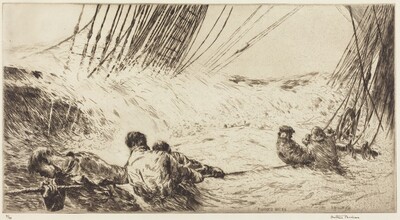
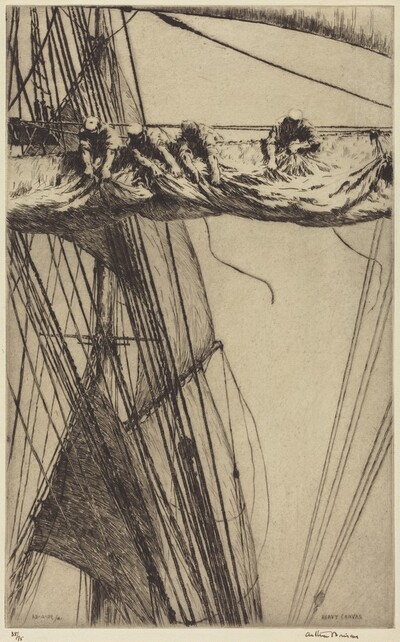
'Man Overboard' is one of Briscoe's most dramatic subjects, depicting the moment of crisis when a sailor falls from a ship into the sea. The composition captures the urgency of the situation: the ship's rail where the man went over, the small figure in the water, and the crew's response. The pen and brown ink gives the rigging and hull their structural precision, while the watercolor provides the sea's movement and the atmospheric conditions that make the rescue so difficult. The 1926 date places this in Briscoe's most productive period as an etcher and watercolorist.
Cultural Impact
The man overboard subject connects Briscoe to the long tradition of maritime disaster painting, but his treatment is distinctive because of his firsthand knowledge of sailing ships. The details of the crew's response — the life ring, the heaving line, the ship's maneuvering — are technically accurate in a way that a studio artist's treatment would not be. Briscoe's 'Man Overboard' is both a dramatic image and a technical document of the emergency procedures of working sail.
Why It Matters
Man Overboard is Briscoe's most dramatic maritime subject: the moment when the routine of sailing becomes life-and-death. The technical accuracy of the crew's response — learned from years at sea — gives the drawing an authenticity that purely imaginative disaster paintings cannot match.