Provenance
Sir Robert Walpole, 1st earl of Orford [1676-1745], Houghton Hall, Norfolk; by inheritance to his son, Robert Walpole, 2nd earl of Orford [1700-1751], Houghton Hall; by inheritance to his son, George Walpole, 3rd earl of Orford [1730-1791], Houghton Hall; sold 1779, through Count Aleksei Semonovich Musin-Pushkin, Russian ambassador to England, to Catherine II, empress of Russia [1729-1796], Saint Petersburg; Imperial Hermitage Gallery, Saint Petersburg, inv. no. 418; sold July 1930, as a painting by Velázquez, through (Matthiesen Gallery, Berlin; P. & D. Colnaghi & Co., London; and M. Knoedler & Co., New York) to Andrew W. Mellon, Pittsburgh and Washington, D.C.; deeded 30 March 1932 to The A.W. Mellon Educational and Charitable Trust, Pittsburgh; gift 1937 to NGA.
Accession Number
1937.1.80
Medium
oil on canvas
Dimensions
overall: 49.2 x 41.3 cm (19 3/8 x 16 1/4 in.) | framed: 78.4 x 69.5 cm (30 7/8 x 27 3/8 in.)
Classification
Painting
Credit Line
Andrew W. Mellon Collection
Background & Context
Background Story
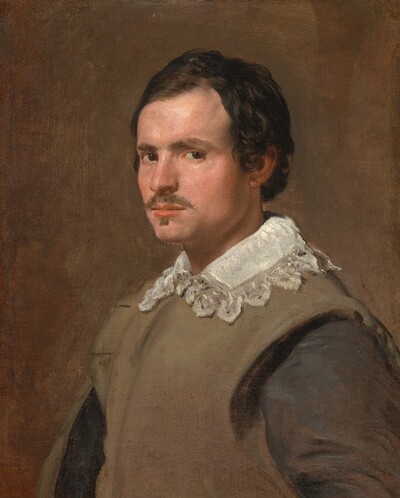
Pope Innocent X by the Circle of Diego Velazquez (c. 1650) is a version of one of the most famous portraits in Western art—Velazquez's masterful portrait of Pope Innocent X Pamphilj, painted during the artist's second trip to Rome in 1650. The original Velazquez portrait, now in the Galleria Doria Pamphilj in Rome, is renowned for its unflinching psychological penetration and brilliant brushwork. This circle version reflects the enormous impact the original had on artists and patrons throughout Europe, sparking demand for copies and variants. The papal portrait tradition demanded images that conveyed both spiritual authority and human presence, and Velazquez's original achieved this with unprecedented realism, reportedly causing the Pope himself to remark It is too true!.
Cultural Impact
Circle versions of Velazquez's Pope Innocent X are important in the history of art because they demonstrate the enormous influence the original had on European portraiture. Velazquez's original portrait revolutionized papal portraiture by replacing the customary idealization with unflinching psychological observation, and the demand for copies and variants spread this revolutionary approach across Europe. The c. 1650 circle version shows how quickly the impact of Velazquez's original was felt, as artists in his immediate circle sought to reproduce the unprecedented realism that made the original so famous.
Why It Matters
This Circle of Velazquez version of Pope Innocent X captures the impact of one of the most famous portraits in Western art. The c. 1650 painting shows how Velazquez's revolutionary approach to papal portraiture—replacing idealization with psychological penetration—was immediately recognized and reproduced by artists in his circle, spreading the new realism across Europe.