Provenance
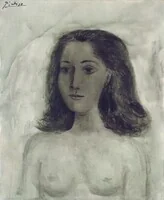
The sitter, Dora Maar [born 1909-alive 1985], Paris;[1] purchased by (Galerie Rosengart, Lucerne); sold 6 July 1951 to Chester Dale [1883-1962], New York; bequest 1963 to NGA.
[1] Provenance compiled from information in object file (1963.10.193) in NGA curatorial records.
Accession Number
1963.10.193
Medium
oil on linen
Dimensions
overall: 73 x 60.2 cm (28 3/4 x 23 11/16 in.) | framed: 102.9 x 89.5 x 5 cm (40 1/2 x 35 1/4 x 1 15/16 in.)
Classification
Painting
Credit Line
Chester Dale Collection
Tags
Painting Early Modern (1901–1950) Oil Painting Spanish Color: White Color: Gray
Background & Context
Background Story
Pablo Picasso painted this portrait of Dora Maar in 1941, during the Nazi occupation of Paris. Maar — born Henriette Theodora Markovitch — was a Surrealist photographer and Picasso's lover from 1936 to 1943. She had documented the creation of Guernica through her celebrated photographic series and became the most painted woman in Picasso's wartime output.
The portrait depicts Maar seated in a chair, her face rendered in Picasso's signature fractured Cubist style — simultaneously frontal and in profile. Her vivid green fingers rest against her cheek; her eyes radiate intensity. The chair's angular arms appear to cage her. The color palette oscillates between warm reds and cool blues, creating psychological tension that mirrors the fractured reality of occupied Paris.
Maar was far more than a passive muse. She was an accomplished artist who introduced Picasso to photographic experimentation. Their relationship was famously tempestuous. After their separation, she suffered a nervous breakdown, later finding solace in painting and Buddhism. This portrait captures both her formidable presence and the claustrophobic intimacy of wartime confinement.
Cultural Impact
Dora Maar became one of the most iconic subjects of 20th-century portraiture. Her weeping portraits became symbols of anti-fascist suffering. The 1941 portrait challenges the tradition of the passive female muse — Maar's commanding, architectural face refuses to be reduced to a decorative object.
Why It Matters
This portrait is a masterwork of Picasso's wartime period, when he could not exhibit publicly under Nazi rule. It transforms portraiture into a record of psychological and political pressure — a woman's face becoming a map of an occupied city.
![The Watering Place (Horses Bathing) [L'abreuvoir (chevaux au bain)]](https://api.nga.gov/iiif/bbac782b-88ea-4477-97a5-4369aa47b98a/full/400,/0/default.jpg)