Accession Number
148038
Medium
Black chalk on ivory laid paper
Dimensions
39 × 29 cm (15 3/8 × 11 7/16 in.)
Classification
drawings (visual works)
Credit Line
The Leonora Hall Gurley Memorial Collection
Background & Context
Background Story
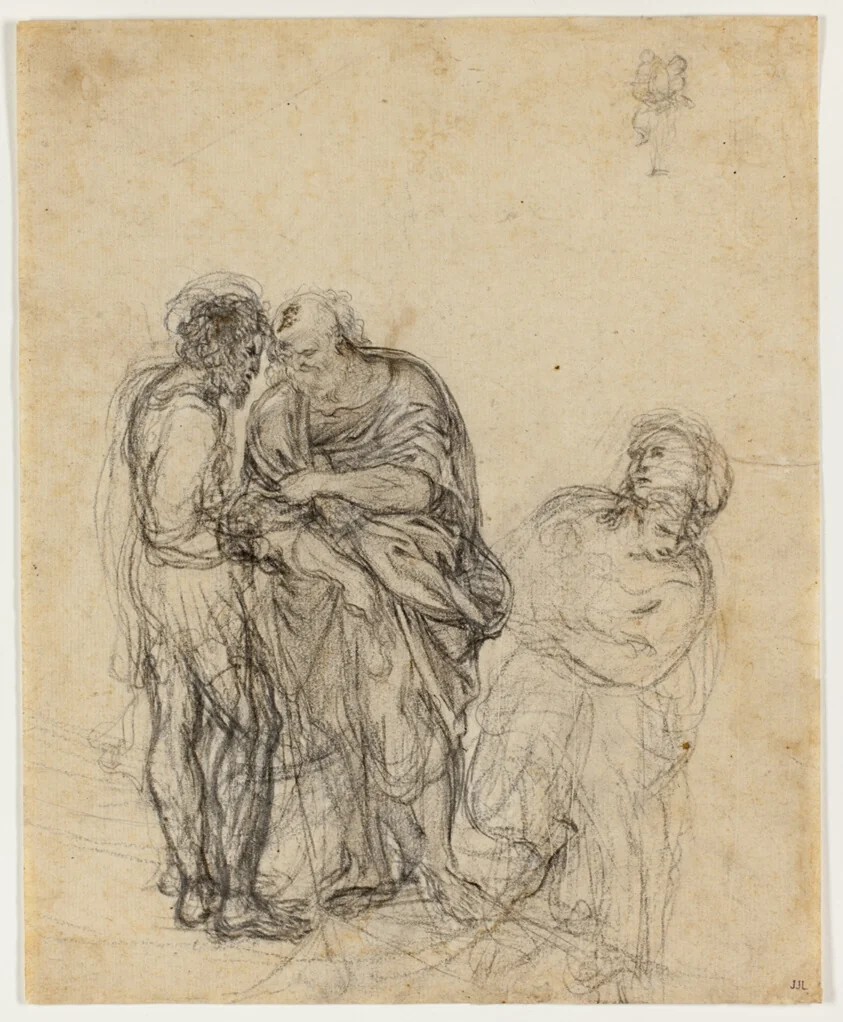
This study of an old man, a younger man, and a woman by Domenichino is a c. 1600–1640 black chalk drawing on ivory laid paper that captures the Bolognese Baroque master in his most observational and preparatory mode, the image showing three figures rendered with the same classical grace and naturalistic warmth that characterized his most famous paintings. The composition is a medium-sized drawing—39 × 29 centimeters—showing three figures in a study that suggests both the artist's observation of human types and his preparation for a larger narrative composition, the black chalk creating a surface of extraordinary delicacy and tonal variation. The ivory laid paper provides a warm, luminous ground that makes the black chalk lines appear rich and substantial, enhancing the sense of three-dimensional form and classical harmony. The c. 1600–1640 date places this work in the period of Domenichino's mature career in Rome and Naples, when he was producing the drawings and paintings that established his reputation as the leading heir to the Carracci academic tradition. Art historians have connected this study to the broader tradition of the figure study in Baroque art, from the drawings of Annibale Carracci to the academy studies of the French classical tradition, noting that Domenichino's treatment is more focused on the classical beauty and the compositional harmony, the transformation of observed reality into idealized form, than the naturalistic observation or the expressive distortion of these other traditions.
Cultural Impact
This c. 1600–1640 chalk study made three figures classically harmonious through medium 39cm delicate tonal variation and ivory-paper warm substantiality, using mature Carracci-academic lineage to transform human-type observation into idealized preparatory composition beyond French academy expressive naturalism.
Why It Matters
It matters because Domenichino drew three people and made the paper feel like it was already arranged into a painting—proving that even a study could be a family if the chalk was graceful enough.