Accession Number
151320
Medium
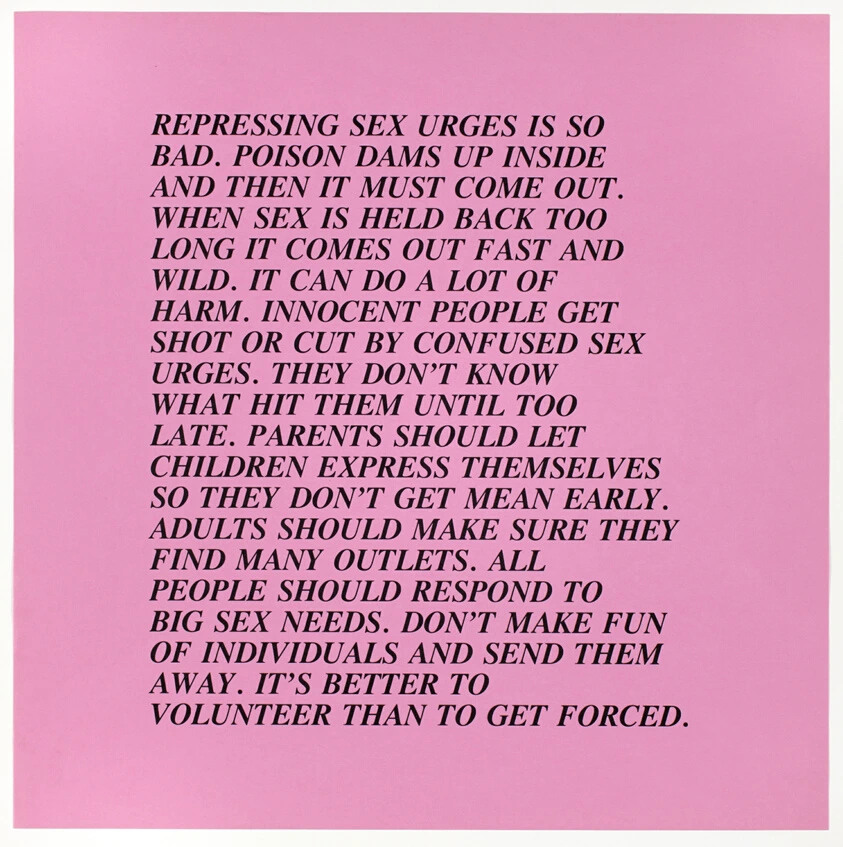
Offset lithograph in black on pink wove paper
Dimensions
54.2 × 54.2 cm (21 3/8 × 21 3/8 in.)
Classification
offset lithograph
Credit Line
Gift of David C. and Sarajean Ruttenberg
Background & Context
Background Story
"Untitled (Repressing Sex Urges...), from Inflammatory Essays" is a 1979/82 offset lithograph by Jenny Holzer that demonstrates the American conceptual artist's engagement with the psychology and ideology of desire, the text printed in black on pink wove paper with the same confrontational directness that characterized the entire series. The composition is a square—54.2 × 54.2 centimeters—the format suggesting both the personal note and the public announcement, the text exploring the repression of sexual urges with a clinical detachment that is simultaneously analytical and provocative, the coldness of the language contrasting with the heat of the subject. The pink wove paper adds a layer of irony and ambiguity, the color associated with femininity and romance serving as the ground for a text that discusses sexual repression with the detachment of a case study. The 1979/82 date places this work in the same period as the other "Inflammatory Essays," suggesting that Holzer was systematically exploring the full range of psychological and social themes through the same format and medium, each essay offering a different critique of contemporary ideology. Art historians have compared this work to the feminist art of the 1970s and the psychoanalytic theory of Freud and Lacan, noting that Holzer's treatment is more focused on the language of repression, the words and phrases that construct and control desire, than the personal confession or the political manifesto of these other traditions.
Cultural Impact
This 1979/82 offset lithograph made sexual-urge repression clinically provocative through pink-paper feminine irony and square-format public-private ambiguity, using detached case-study language to critique desire-construction ideology beyond 1970s feminist personal confession.
Why It Matters
It matters because Holzer printed words about repressed desire on pink paper and made the poster feel like it was both blushing and analyzing—proving that even a sentence could be a symptom if the color was right.