Provenance
Charles Deering (1852–1927), Chicago [stamp (Lugt 516), recto, lower right, in blue]; by descent to his daughters, Mrs. Chauncey McCormick (née Marion Deering; 1886–1965), Chicago and Mrs. Richard Ely Danielson (née Barbara Deering; 1885–1957), Chicago; given to the Art Institute of Chicago, 1927.
Accession Number
55000
Medium
Red chalk, with stumping, on ivory laid paper
Dimensions
64.5 × 42.4 cm (25 7/16 × 16 3/4 in.)
Classification
drawings (visual works)
Credit Line
The Charles Deering Collection
Background & Context
Background Story
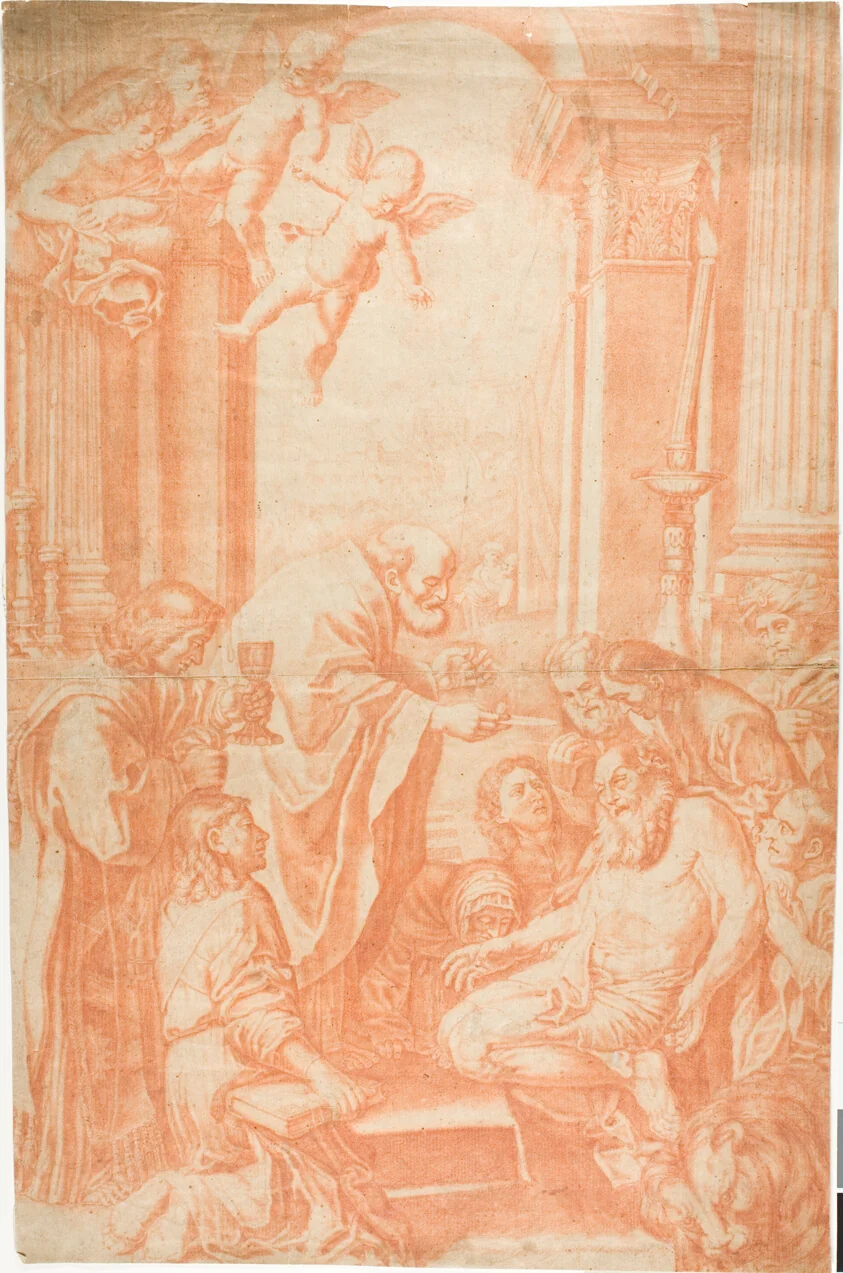
"The Last Communion of Saint Jerome" is an after 1614 red chalk drawing with stumping on ivory laid paper by Domenichino that demonstrates the Bolognese Baroque master's engagement with one of the most beloved themes of Counter-Reformation art, the image showing the dying saint receiving the Eucharist with the same classical restraint and spiritual warmth that made Domenichino the leading religious painter of the Roman Baroque. The composition is a large drawing—64.5 × 42.4 centimeters—showing the moment of communion rendered with the rich, velvety reds of the chalk and the soft, atmospheric effects of stumping on ivory laid paper, the technique creating a surface of extraordinary warmth and devotional intimacy. The red chalk creates bold, expressive lines that suggest both the physical presence of the figures and the spiritual nobility of the moment, while the stumping creates subtle tonal transitions that suggest the soft light of the interior and the hushed reverence of the witnesses. Art historians have connected this drawing to the broader tradition of the last communion image in Baroque art, from the paintings of Agostino Carracci to the altarpieces of Guido Reni, noting that Domenichino's treatment is more focused on the classical restraint and the compositional clarity, the transformation of emotional drama into timeless beauty, than the theatrical intensity or the emotional excess of these other traditions.
Cultural Impact
This after-1614 red chalk drawing made last communion devoutly restrained through large 64cm velvety stumping warmth and ivory-paper hushed reverence, using Counter-Reformation classical clarity to transform emotional drama into timeless spiritual beauty beyond Reni theatrical excess.
Why It Matters
It matters because Domenichino drew a saint's last meal and made the paper feel like it was receiving grace—proving that even a dying man could be beautiful if the chalk was warm enough.