Accession Number
1943.3.1602
Medium
wastercolor over graphite
Dimensions
overall: 13 x 17.6 cm (5 1/8 x 6 15/16 in.)
Classification
Drawing
Credit Line
Rosenwald Collection
Tags
Drawing Impressionist & Modern (1851–1900) Graphite & Pencil Scottish
Background & Context
Background Story
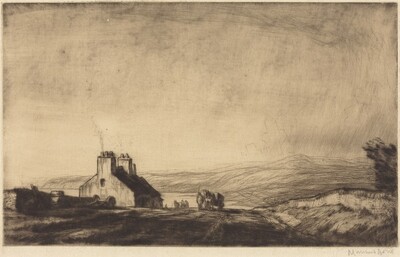
The Abruzzi region of central Italy, with its mountain villages perched on dramatic ridges and its landscape of peaks and valleys, gave Bone a subject that combined Italian architectural character with mountain grandeur. The watercolor over graphite technique — more heavily worked than his usual combination — suggests a subject that required particular attention to tonal relationships: the deep shadows of mountain valleys, the bright highlights of sunlit ridge tops, and the atmospheric distance between them. The Abruzzi villages, with their compact stone architecture clinging to impossible sites, are a natural subject for Bone's architectural sensibility.
Cultural Impact
The Abruzzi was one of the least visited regions of Italy in Bone's time, and his drawings of its villages and landscapes are among the few visual records of the region by a major British artist. Mountain villages had been a subject for painters since the Renaissance, but the specific character of Abruzzi architecture — its combination of defensive compactness and picturesque siting — had rarely been so precisely documented.
Why It Matters
In the Abruzzi is Bone discovering a subject that combines his two primary interests: dramatic architecture in dramatic settings. The mountain villages of central Italy respond to his architectural eye and his landscape sensibility simultaneously, producing drawings that are as structurally informative as they are atmospheric.