Description
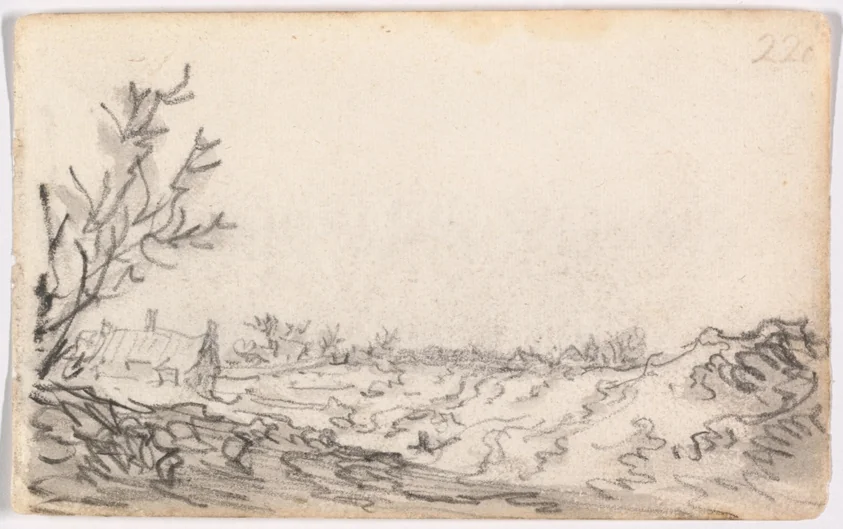
Five drawings (1961.378-1961.382) were once bound in a small sketchbook of approximately 200 pages. Because it was light and portable, Jan van Goyen could tuck it into his pocket while walking in search of inspiration. Sketchbooks allowed the artist to quickly delineate sand dunes and architectural structures in the vicinity of his residence in The Hague and farther afield. These landscape sketches in black chalk and ink wash relate—directly and indirectly—to compositions the artist later realized in oil paintings.
Provenance
Possibly A. Geddes; sold Christie’s, April 1845, lot 361 [Dodgson 1935]. Private collection, England, 1879 [Gorissen 1964]. Johnson Neale, London, by 1895 [Gorrisen 1964]; Thomas Mark Hovell (1853–1925), London [Dodgson 1918]. Sold, Sotheby's, London, July 3, 1918, lot 124, to P. and D. Colnaghi, London [Sotheby Parke Bernet, 1980]. W. M. Mensing [or Anton Mensing? ](1866–1936), Amsterdam; sold, Frederick Muller, Amsterdam, Apr. 27–29, 1937, lot 218. Hirschmann (probably Otto Hirschman, born 1889) [Gorissen 1964]. A. Mayer, New York [Gorissen 1964]. Possibly C. F. Louis deWild (1900–1987), New York [according to Beck]. Sold by Lilienfeld Galleries, New York, to the Art Institute of Chicago, 1961.
Accession Number
20162
Medium
Black chalk, with brush and gray wash, on ivory laid paper
Dimensions
9.8 × 15.8 cm (3 7/8 × 6 1/4 in.)
Classification
chalk
Credit Line
Worcester Sketch Fund Income
Background & Context
Background Story
"A Dune Landscape" is a 1650–51 black chalk drawing with gray wash by Jan van Goyen that documents the Dutch master's lifelong engagement with the coastal dunes of Holland, the landscape that provided both his most characteristic subject and his most subtle explorations of light, atmosphere, and tone. The composition shows a stretch of dunes with the undulating forms and sparse vegetation that characterize the Dutch coast, the black chalk lines creating the contours and textures while the gray wash adds the atmospheric depth that makes the drawing feel both specific and universal, a particular place transformed into a meditation on the nature of landscape itself. The ivory laid paper provides a warm, luminous ground that makes the drawing feel intimate and precious, the small scale—barely 10 × 16 centimeters—creating a sense of privacy and contemplation. The 1650–51 date places this work in the same period as "Village on Sunny Hillside" and the other late drawings, suggesting that van Goyen was systematically exploring the possibilities of the dune landscape in his final years, each drawing offering a different variation on the theme of coastal light and form. Art historians have connected this drawing to the broader tradition of Dutch landscape art, from the detailed realism of Cuyp to the atmospheric poetry of the tonal painters, noting that van Goyen's treatment combines the observational precision of the former with the emotional depth of the latter. The work also demonstrates the influence of drawing on Dutch painting: the freedom and spontaneity of the chalk sketch informed the painterly handling of van Goyen's oils, the two practices enriching each other through their differences of scale and medium.
Cultural Impact
This 1650–51 chalk drawing made coastal dunes universally meditative through undulating contour precision and atmospheric gray-wash depth, using ivory-paper intimacy to balance Cuyp-like observation with tonal-poetry emotional abstraction.
Why It Matters
It matters because van Goyen drew a dune and made the sand feel like it was moving—proving that even a handful of chalk could hold the whole coast if the wash was patient enough.


