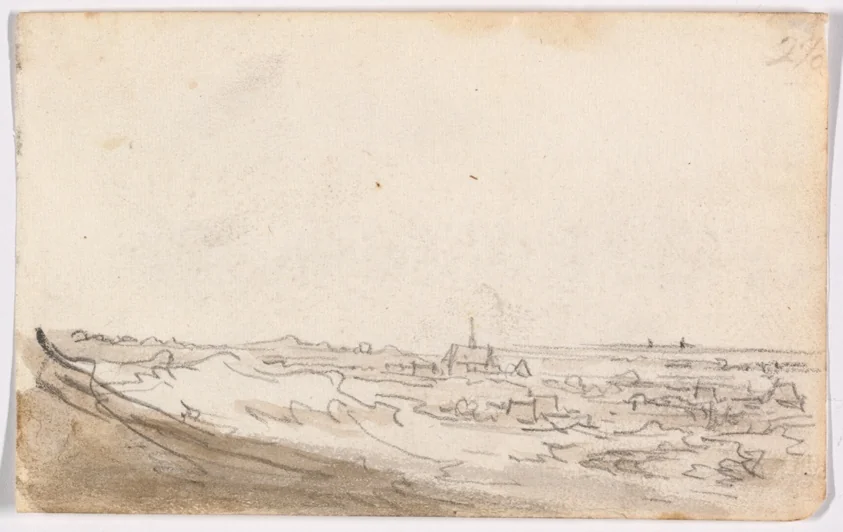
Description
Five drawings (1961.378-1961.382) were once bound in a small sketchbook of approximately 200 pages. Because it was light and portable, Jan van Goyen could tuck it into his pocket while walking in search of inspiration. Sketchbooks allowed the artist to quickly delineate sand dunes and architectural structures in the vicinity of his residence in The Hague and farther afield. These landscape sketches in black chalk and ink wash relate—directly and indirectly—to compositions the artist later realized in oil paintings.
Provenance
Possibly A. Geddes; sold Christie’s, April 1845, lot 361 [Dodgson 1935]. Private collection, England, 1879 [Gorissen 1964]. Johnson Neale, London, by 1895 [Gorrisen 1964]; Thomas Mark Hovell (1853–1925), London [Dodgson 1918]. Sold, Sotheby's, London, July 3, 1918, lot 124, to P. and D. Colnaghi, London [Sotheby Parke Bernet, 1980]. W. M. Mensing [or Anton Mensing? ](1866–1936), Amsterdam; sold, Frederick Muller, Amsterdam, Apr. 27–29, 1937, lot 218. Hirschmann (probably Otto Hirschman, born 1889) [Gorissen 1964]. A. Mayer, New York [Gorissen 1964]. Possibly C. F. Louis deWild (1900–1987), New York [according to Beck]. Sold by Lilienfeld Galleries, New York, to the Art Institute of Chicago, 1961.
Accession Number
20161
Medium
Black chalk, with brush and brown wash, on ivory laid paper
Dimensions
9.8 × 15.7 cm (3 7/8 × 6 3/16 in.)
Classification
chalk
Credit Line
Worcester Sketch Fund Income
Background & Context
Background Story
"Panorama" is a 1650–51 black chalk drawing with brown wash by Jan van Goyen that demonstrates the Dutch master's mastery of the panoramic view, the wide-angle composition suggesting both the flatness of the Dutch landscape and the vastness of the sky that dominates it. The composition shows an extensive view—probably of the Dutch countryside with its fields, waterways, and distant horizon—the black chalk providing the linear structure while the brown wash adds the tonal gradations that create the sense of atmospheric depth and spatial recession. The use of brown wash rather than gray creates a warmer, more golden atmosphere, suggesting either a different time of day or a different emotional register from the cooler drawings in the series. The ivory laid paper provides the same warm ground that unifies the late drawings, the support becoming part of the image through the harmony of tone. The 1650–51 date places this work in the same period as the other late drawings, suggesting that van Goyen was exploring the full range of his native landscape in his final years, from the intimate village scenes to the expansive panoramic views. Art historians have compared this drawing to the panoramic paintings of Philips Koninck and the wide-angle landscapes of the Italian vedutisti, noting that van Goyen's treatment is more atmospheric, more focused on the mood and light of the scene than the topographical or architectural content of these predecessors.
Cultural Impact
This 1650–51 panoramic drawing made Dutch flatness vast through wide-angle brown-wash golden warmth, using black-chalk linear structure to balance atmospheric depth with Koninck-style topographical ambition in late-career landscape exploration.
Why It Matters
It matters because van Goyen drew the whole horizon and made the paper feel like it was stretching—proving that even a small sheet could hold the sky if the brown wash was warm enough.


