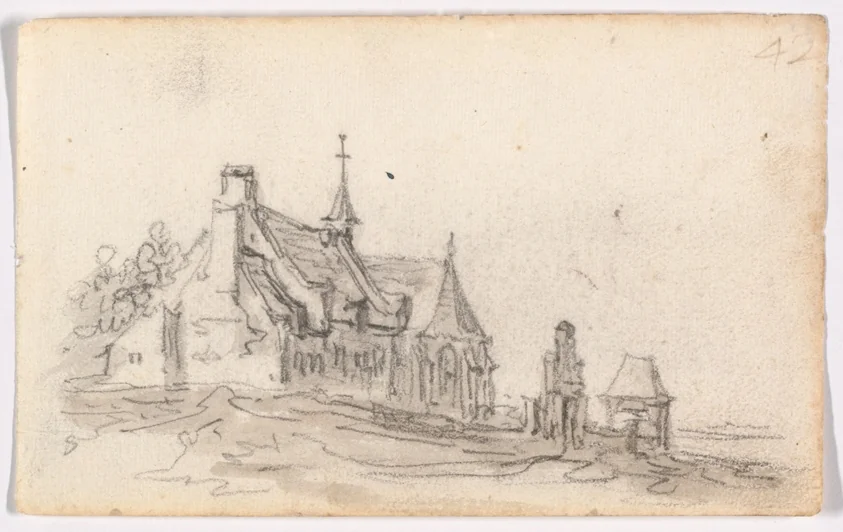
Description
Five drawings (1961.378-1961.382) were once bound in a small sketchbook of approximately 200 pages. Because it was light and portable, Jan van Goyen could tuck it into his pocket while walking in search of inspiration. Sketchbooks allowed the artist to quickly delineate sand dunes and architectural structures in the vicinity of his residence in The Hague and farther afield. These landscape sketches in black chalk and ink wash relate—directly and indirectly—to compositions the artist later realized in oil paintings.
Provenance
Possibly A. Geddes; sold Christie’s, April 1845, lot 361 [Dodgson 1935]. Private collection, England, 1879 [Gorissen 1964]. Johnson Neale, London, by 1895 [Gorrisen 1964]; Thomas Mark Hovell (1853–1925), London [Dodgson 1918]. Sold, Sotheby's, London, July 3, 1918, lot 124, to P. and D. Colnaghi, London [Sotheby Parke Bernet, 1980]. W. M. Mensing [or Anton Mensing? ](1866–1936), Amsterdam; sold, Frederick Muller, Amsterdam, Apr. 27–29, 1937, lot 218. Hirschmann (probably Otto Hirschman, born 1889) [Gorissen 1964]. A. Mayer, New York [Gorissen 1964]. Possibly C. F. Louis deWild (1900–1987), New York [according to Beck]. Sold by Lilienfeld Galleries, New York, to the Art Institute of Chicago, 1961.
Accession Number
20159
Medium
Black chalk, with brush and gray wash, on ivory laid paper
Dimensions
9.8 × 15.8 cm (3 7/8 × 6 1/4 in.)
Classification
chalk
Credit Line
Worcester Sketch Fund Income
Background & Context
Background Story
A black chalk and gray wash drawing by van Goyen depicting a leper house at the Dutch-German border town of Cleves, combining social documentation of 17th-century charitable institutions with the atmospheric economy and tonal subtlety that made him the most imitated landscape draftsman of the Dutch Golden Age.
Cultural Impact
Van Goyens drawings of specific buildings are invaluable documents of the 17th-century Dutch landscape and its built environment, preserving images of structures that have since disappeared. The Leper House exemplifies his ability to find pictorial interest in overlooked subjects.
Why It Matters
Van Goyen tonal landscape drawing of a leper house at Cleves combines social documentation with atmospheric subtlety, using black chalk and gray wash to suggest weathered stone and historical depth.


