Provenance
Captain Edward H. Molyneux [1891-1974], Paris, by 1952;[1] sold 15 August 1955 to Ailsa Mellon Bruce [1901-1969], New York; bequest 1970 to NGA.
[1] The painting was exhibited with the Molyneux collection in New York and Washington in 1952. Sale to Ailsa Mellon Bruce according to her collection notebook, now in NGA archives (copy in NGA curatorial records).
Accession Number
1970.17.22
Medium
oil on paper on canvas
Dimensions
overall: 25 x 33.6 cm (9 13/16 x 13 1/4 in.) | framed: 48.6 x 56.5 x 6.4 cm (19 1/8 x 22 1/4 x 2 1/2 in.)
Classification
Painting
Credit Line
Ailsa Mellon Bruce Collection
Tags
Painting Neoclassical & Romantic (1751–1850) Oil Painting Canvas French Color: Gold
Background & Context
Background Story
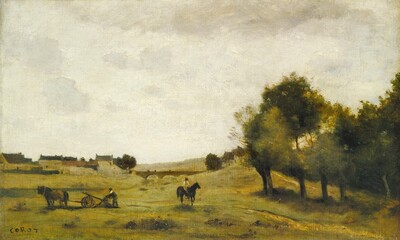
Bridge on the Saône River at Mâcon (1834) is one of Corot's early landscape studies, painted during the period when he was developing the approach to outdoor painting that would influence the Impressionists. The Saône, a major tributary of the Rhône, flowed through the Burgundy city of Mâcon, and its bridge—a functional structure connecting the city's two halves—provided Corot with a subject that combined architectural interest with the river landscape's natural beauty. The year 1834 places this during Corot's formative period, when he was traveling through France making the oil sketches that would become the foundation of his landscape method. The painting likely retains the directness and freshness of a work made on location, before Corot had developed the more poetic handling that would characterize his later work. The bridge itself—a stone structure spanning the river—creates a strong horizontal element that organizes the composition, while the river's reflective surface provides the light effects that would become Corot's specialty. The painting documents a specific French location at a specific historical moment—the 1830s, when France's infrastructure was being modernized under the July Monarchy—and combines topographical accuracy with the atmospheric sensitivity that Corot's landscape method demanded.
Cultural Impact
Corot's early landscape studies influenced the development of plein-air painting in France, establishing methods that the Impressionists would later adopt and extend. The bridge subject influenced how French infrastructure was represented in art, connecting architectural subjects to landscape painting. The Saône River subjects influenced how provincial France was visually documented, recording places that the Parisian art world rarely depicted.
Why It Matters
This painting matters because it represents the formative stage of Corot's landscape method—the period when his direct observation of French scenery was producing the oil sketches that would influence the entire history of outdoor painting. The Bridge at Mâcon captures the simplicity and freshness of a young artist looking carefully at a specific place rather than composing an ideal landscape from imagination.