Provenance
Daniel-Henry Kahnweiler, Paris, by Oct. 1912 [London 1912]; sold to Arthur Jerome Eddy (1859-1920), Chicago, May 2, 1913 [letter from Treasurer to Henry Kahnweiler, May, 2, 1913, Walter Kuhn Papers, Archives of American Art, Series 1, Subseries 1:6, Box 1, Folder 70, copy in curatorial file]; by descent to his wife Lucy O. Eddy (1863-1931) and son Jerome O. Eddy (1891-1951), Chicago, 1920; given to the Art Institute of Chicago, 1931.
Accession Number
20314
Medium
Oil on canvas
Dimensions
73.7 × 92.1 cm (29 × 36 1/4 in.)
Classification
Painting
Credit Line
Arthur Jerome Eddy Memorial Collection
Background & Context
Background Story
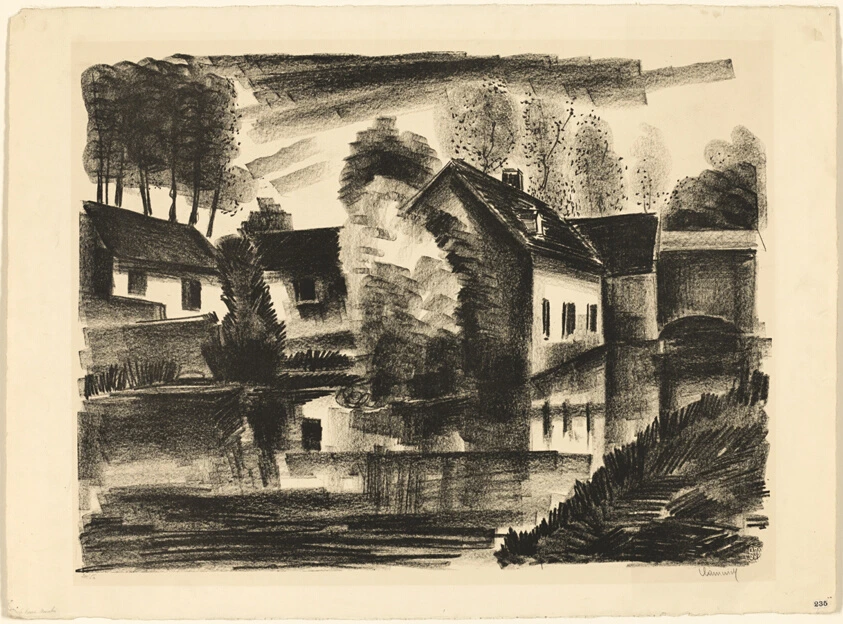
Maurice de Vlaminck's Village (c. 1912) is an oil on canvas from the period after Fauvism, when Vlaminck's style had evolved toward a more structured, less coloristic approach. The painting shows a village landscape, the forms more solid and the palette more restrained than his Fauvist works. The influence of Cezanne is evident in the simplified forms and the careful construction of the composition.
Cultural Impact
Vlaminck's post-Fauvist works show his evolution toward a more structured style influenced by Cezanne.
Why It Matters
This village landscape shows Vlaminck's post-Fauvist evolution, the forms more solid and structured than his earlier explosive works.