Provenance
The artist; Daniel-Henry Kahnweiler (1884–1979), June 1921 [stock no. 6659; letter from Maurice Jardot of Galerie Louise Leiris to Courtney Donnell, Aug. 1976, in curatorial file]; sold, Hôtel Drouot, Paris, June 13–14, 1921, Kahnweiler sequestration sale, lot 55, to “Grassat” for Galerie Simon [Cooper 1977]; consigned to de Hauke and Company, New York, Sept. 6, 1929 [letter from Galerie Simon to De Hauke and Co., Jan. 6, 1930, Jacques Seligmann & Co. Records, Archives of American Art, Smithsonian Institution; De Hauke & Co., Inc. Records, Box 394, Folder 9, copy in curatorial object file]; sold through De Hauke and Company, New York, to Walter S. Brewster (1872–1954), Chicago, Apr. 22, 1930 [Bound Stock Catalog, Paintings and Pastels no. 2, 1927-1931, page 26; Jacques Seligmann & Co. Records, Archives of American Art, Smithsonian Institution; De Hauke & Co., Inc. Records, Box 284, Folder 8, copy in curatorial object file]; bequeathed by his wife, Kate Brewster (1897–1947) to the Art Institute of Chicago, Jan. 12, 1950.
Accession Number
68395
Medium
Oil on canvas
Dimensions
45.7 × 37.8 cm (18 × 14 7/8 in.)
Classification
Painting
Credit Line
Bequest of Kate L. Brewster
Background & Context
Background Story
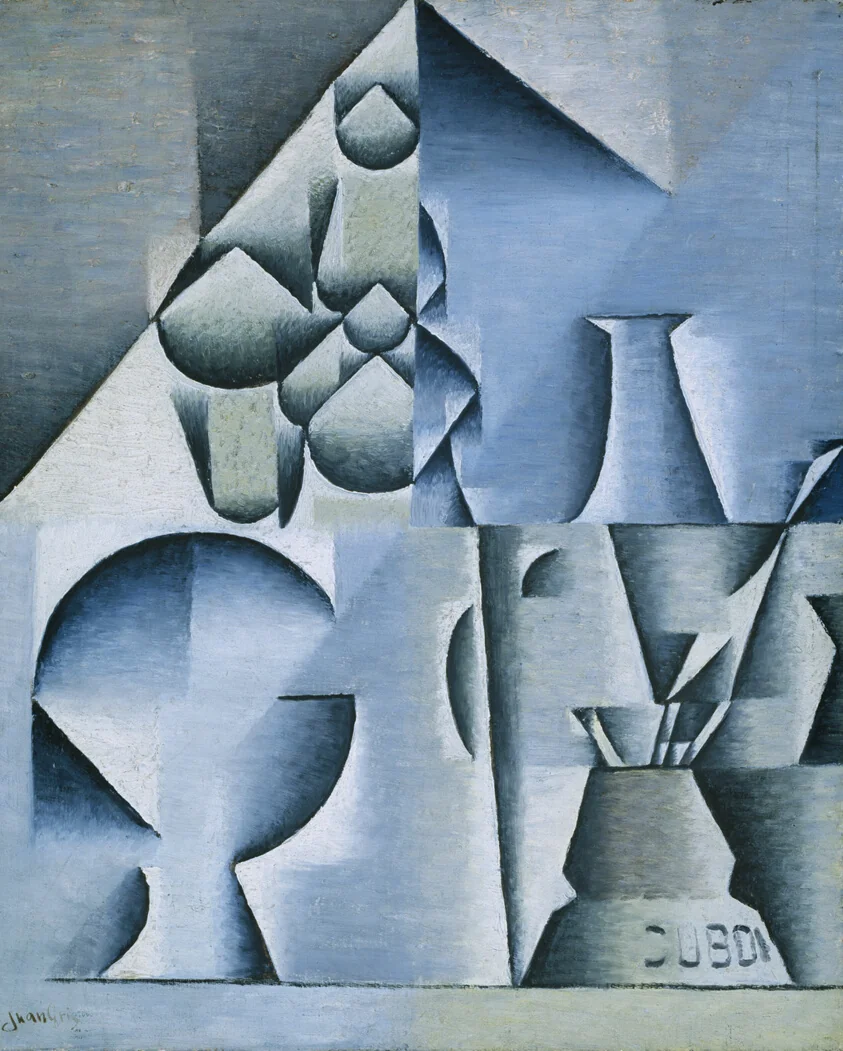
Juan Gris's Table at a Café (1912) is an oil on canvas from the early period of Gris's Cubist work, the year he began to exhibit in the Cubist rooms of the Salon des Indépendants. The subject of a café table was a classic Cubist theme, offering a rich array of objects—glasses, bottles, newspapers, playing cards—that could be analyzed and reconstructed through Cubist techniques. Gris's treatment shows the café table with its characteristic objects, the forms broken down and reassembled in the Cubist manner. The palette is limited to the muted browns, grays, and earth tones typical of early Cubism. The composition is flattened and fragmented, the objects overlapping and interpenetrating in the ambiguous space of the Cubist picture plane. Table at a Café is an important early work in Gris's career, demonstrating his immediate mastery of the Cubist idiom and his ability to bring his own systematic intelligence to the movement.
Cultural Impact
Gris's early Cubist paintings of 1912 demonstrate his immediate mastery of the Cubist idiom, establishing him as the third member of the Cubist movement alongside Picasso and Braque.
Why It Matters
This early Cubist painting of a café table captures the characteristic subjects and techniques of the movement, Gris's systematic approach already evident in the analysis of forms and the construction of pictorial space.


