Provenance
Mima de Manziarly Porter, Chicago and New York, by Jan. 26, 1930 [letter from Mrs. K. F. Simpson, Jan. 26, 1930, copy in curatorial file]; bequeathed to the Art Institute of Chicago, 1989.
Accession Number
73644
Medium
Oil and sand on cardboard
Dimensions
29.2 × 19.7 cm (11 1/2 × 7 3/4 in.)
Classification
Painting
Credit Line
Bequest of Mima de Manziarly Porter
Background & Context
Background Story
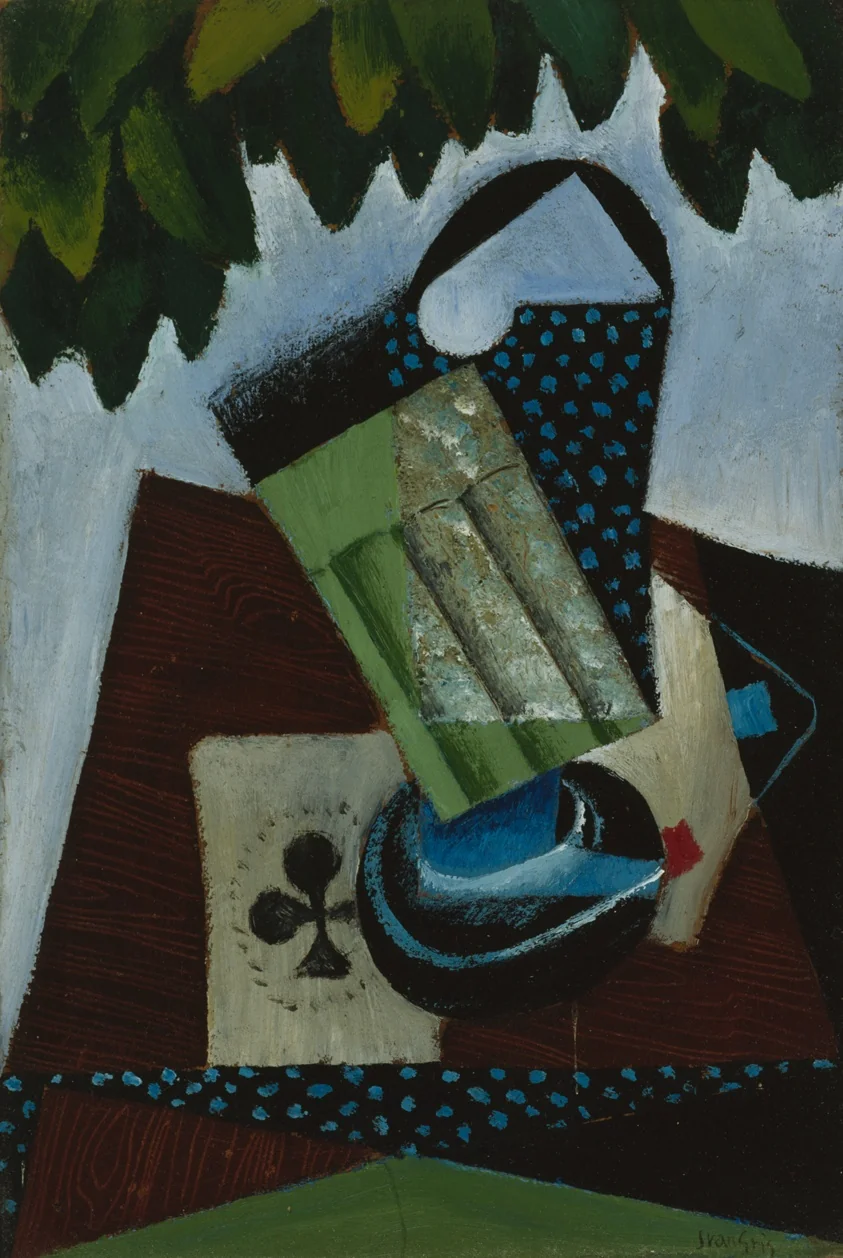
Juan Gris's Glass and Playing Cards (1915) is an oil and sand on cardboard still life that incorporates sand into the paint to create a textured surface. The addition of sand was a technique Gris used in several works of this period, adding a material dimension to the visual experience. The subject—a glass and playing cards on a table—was a classic Cubist motif, allowing Gris to explore the relationship between transparent and opaque forms, between flat and three-dimensional objects. The composition is organized around the verticals and horizontals of the cards and the curves of the glass. The palette is more varied than the early Cubist works, with areas of brighter color. The cardboard support gives the painting a more intimate, sketch-like quality. Glass and Playing Cards is a masterwork of Gris's Synthetic Cubist period, demonstrating his ability to combine formal innovation with the representation of everyday life.
Cultural Impact
Gris's sand-painted works represent his experimental approach to materials, adding a tactile dimension to the visual experience of Cubist painting.
Why It Matters
This still life of a glass and playing cards combines Cubist formal analysis with innovative use of sand-textured paint, the varied materials creating a composition of visual and tactile complexity.


