Accession Number
48771
Medium
Color soft ground etching from four copper plates, sugar lift, and aquatint, on off-white wove paper
Dimensions
Image/plate: 32 × 26.3 cm (12 5/8 × 10 3/8 in.); Sheet: 71.7 × 56 cm (28 1/4 × 22 1/16 in.)
Classification
etching
Credit Line
Purchased with funds provided by the Stanley M. Freehling Family Foundation
Background & Context
Background Story
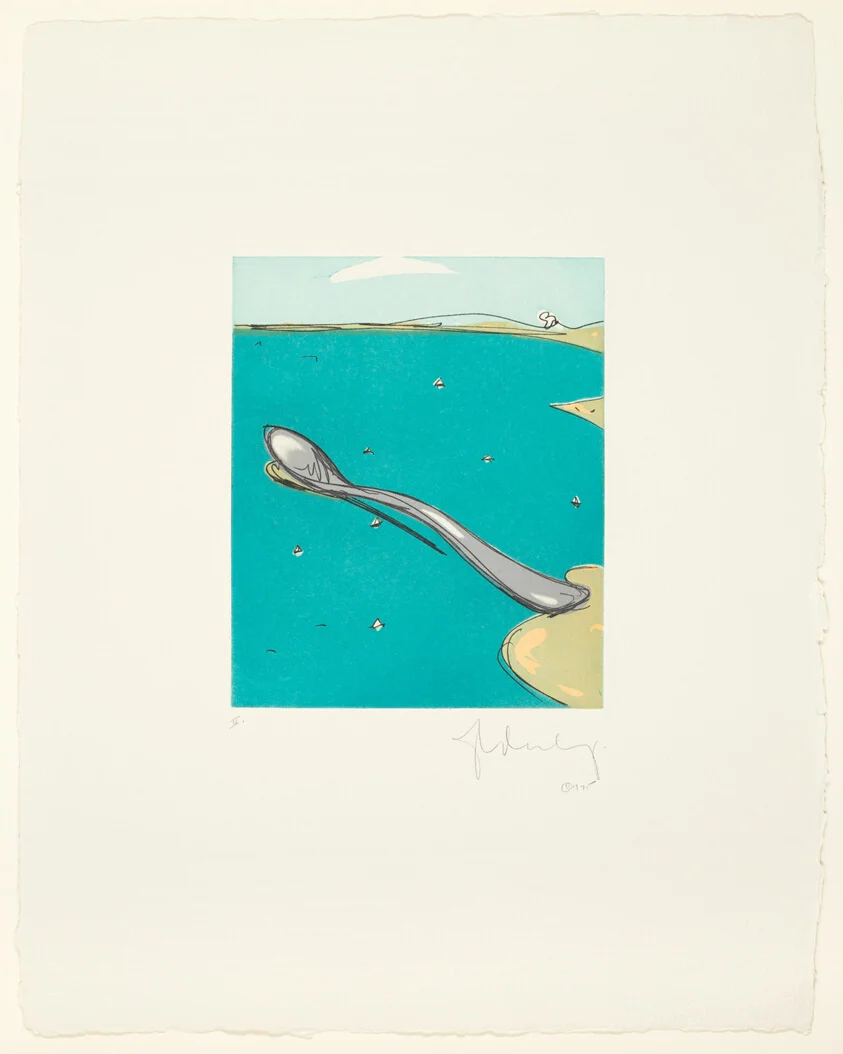
Claes Oldenburgs Spoon Pier from 1975 is an etching that depicts one of the artists proposed but never realized large-scale public sculptures: a pier in the shape of a giant spoon, extending from a shoreline into a body of water. The print combines the technical sophistication of color soft ground etching from four copper plates with sugar lift and aquatint, producing a rich surface that captures both the physical texture of the imagined structure and the atmospheric effects of water, sky, and light. Spoon Pier belongs to Oldenburgs extensive series of proposed monuments, visionary projects that took familiar domestic objects and reimagined them at architectural scale as public sculptures: a giant teddy bear replacing the Statue of Liberty, a colossal clothespin for Philadelphia City Hall, a huge ballcock for a reservoir. Some of these proposals were eventually realized, while others existed only as drawings and prints. The spoon as pier is a characteristic Oldenburg transformation: the spoons bowl becomes a sheltered harbor, its handle a walkway extending over the water, and the logic of scale reversal turns a utensil designed for the mouth into a structure designed for the city. The etchings four-plate color technique allows Oldenburg to suggest the play of light on water and the material presence of the proposed structure with a subtlety that distinguishes the print medium from drawing.
Cultural Impact
Oldenburgs proposed monument prints constitute one of the most sustained exercises in architectural imagination in postwar art, suggesting that urban infrastructure could be reimagined through the logic of everyday objects. The realization of some of these proposals as actual sculptures, most notably the Clothespin in Philadelphia and the Spoon Bridge in Minneapolis, has permanently altered the public art landscape.
Why It Matters
A technically ambitious four-plate color etching by Oldenburg depicting a proposed spoon-shaped pier, exemplifying his lifelong project of reimagining public sculpture through the transformation of domestic objects into monumental forms.