Lion Hunt

Description

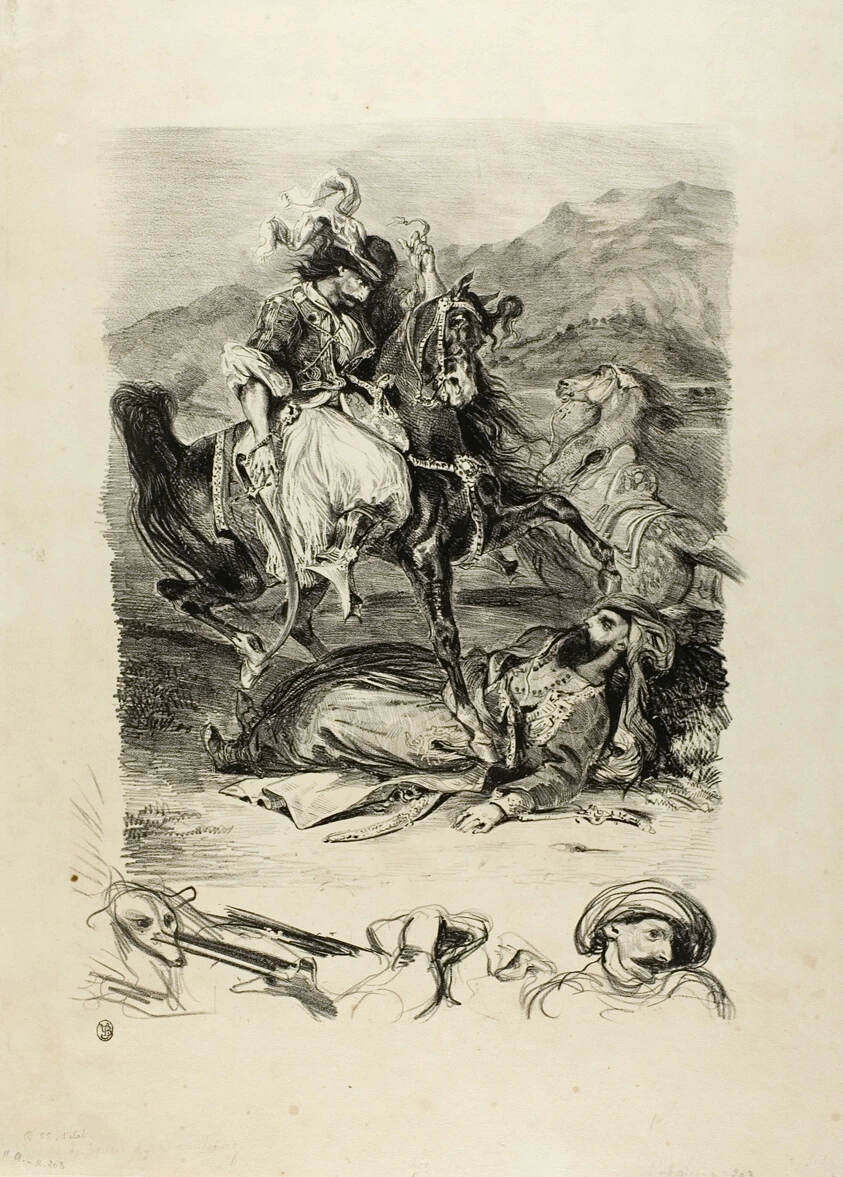
In 1832 Eugène Delacroix joined a diplomatic envoy to French-colonized Algeria. The sights and experiences from this six-month journey fueled the rest of his career, lending his canvases an illusion of accuracy that his less-traveled competitors lacked. The artist expressed in his journals from abroad his admiration for Arab culture, even characterizing it as superior to that of post-revolutionary France. Nevertheless, in paintings like this he catered to violent European fantasies about the Arab world. Having never witnessed a lion hunt, Delacroix skillfully synthesized studies of landscapes, Islamic costume, and zoo animals to bring this narrative to life with theatrical intensity.

Provenance

Possibly sold from the artist to Vaisse for 2,500 francs [this and the following information according to Johnson 1989]. Comte d’Aquila; his sale, February 21-22, 1868, lot 7, sold for 14,505 francs. Faure, Paris, 1885 [according to Robaut 1885; see also catalogue of 1892 sale citied below]. R. Austin Robertson, New York; his estate sale, New York, American Art Association, April 7, 1892, lot 147 (ill.); sold for 13,000 francs to Mr. and Mrs. Potter Palmer, Chicago; bequeathed to the Art Institute, 1922.

Lion Hunt

Eugène Delacroix

1860–61

Accession Number

81505

Medium

Oil on canvas

Dimensions

76.5 × 98.5 cm (30 × 38 1/2 in.); Framed: 105.5 × 125.8 cm (41 1/2 × 49 1/2 in.)

Classification

Painting

Museum

The Art Institute of Chicago

Chicago, United States

Credit Line

Potter Palmer Collection
Background & Context

Background Story

"Lion Hunt" is one of Delacroix's most violent and exhilarating late canvases, painted between 1860 and 1861 when the artist was in his sixties and still producing works of explosive physical energy that belied his declining health. The composition shows a group of North African hunters struggling with a lion in a wilderness of dust, blood, and flailing bodies, the scene rendered with the loose, almost chaotic brushwork that Delacroix had developed to convey movement and danger without the narrative clarity of academic history painting. The palette is dominated by earth tones—ochres, browns, and the deep reds of blood—creating an atmosphere of primal savagery that contrasts with the more decorative color of his earlier Moroccan scenes. The lion itself is the true protagonist of the canvas: its muscular body, gaping jaws, and wild eyes emerge from the surrounding chaos with the ferocious dignity that Delacroix had learned from studying Rubens's hunting scenes and the animal paintings of Frans Snyders. The human figures are almost incidental, their faces contorted with fear or determination as they struggle to contain an elemental force that cannot be dominated. This theme of the hunt as metaphysical struggle was central to Delacroix's imagination: he painted numerous versions of lion hunts throughout his career, each one exploring the boundary between civilization and barbarism, control and chaos. Art historians have compared this late canvas to the earlier "Lion Hunt" of 1855, noting that the 1860 version is more abstract, less concerned with topographical accuracy than with pure painterly energy. The work influenced the development of action painting in the twentieth century: the swirling composition and gestural brushwork anticipate the explosive canvases of de Kooning and the Abstract Expressionists.

Cultural Impact

This late hunting canvas channeled Rubens and Snyders into primal Abstract Expressionist energy, using earth-toned savagery to explore civilization's boundary with elemental chaos at age sixty.

Why It Matters

It matters because Delacroix painted a lion hunt at sixty like he was twenty—proving that violence in paint could outlast the body that mixed it.