Provenance
Gustave Revenaz, Paris, by 1885 [Paris 1885]. Private Collection, Paris, by 1964 [Bern 1964]. Sold by Wildenstein and Company, New York, to the Art Institute, 1965.
Accession Number
23645
Medium
Gouache and watercolor, with scraping, selectively gum-varnished, on cream wove paper, laid down on tan wove paper
Dimensions
25.2 × 18.7 cm (9 15/16 × 7 3/8 in.)
Classification
watercolor
Credit Line
Helen Regenstein Collection
Background & Context
Background Story
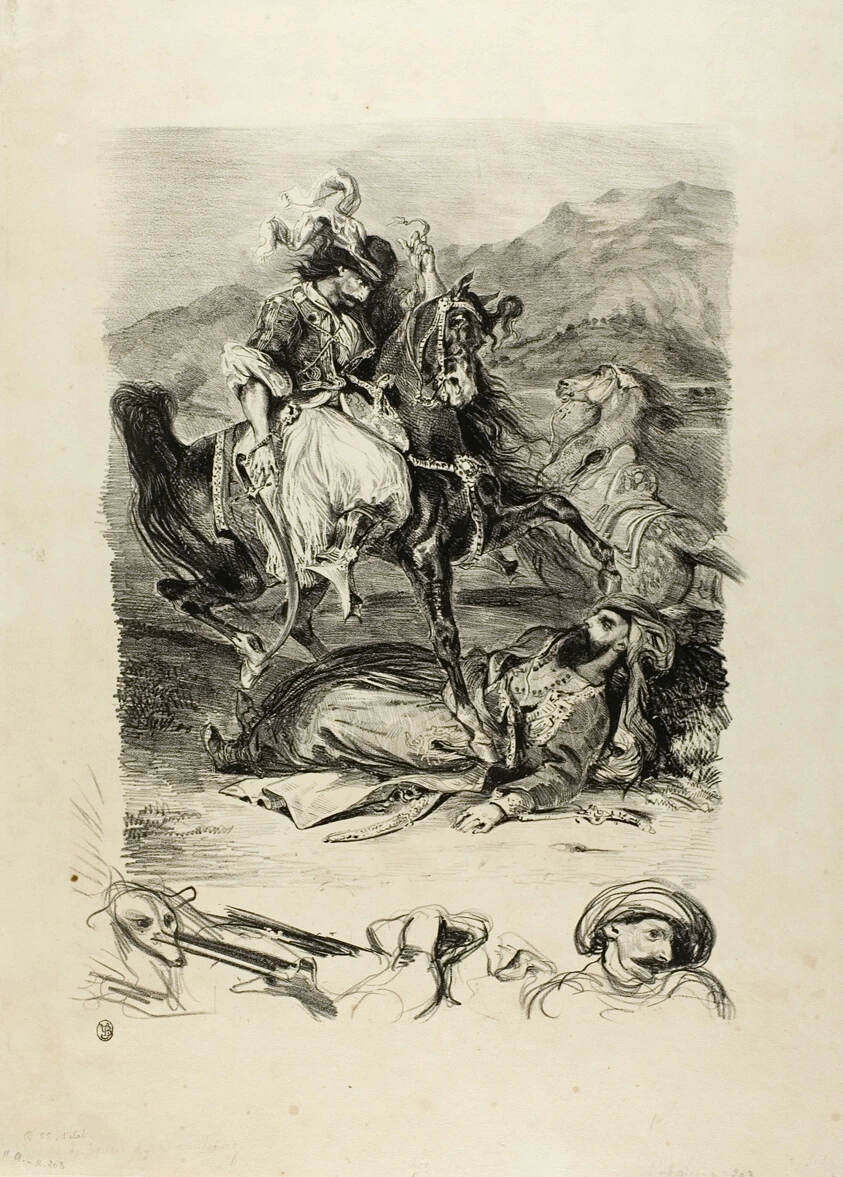
Eugene Delacroixs The Turkish Rider from around 1834 is a gouache and watercolor that captures the Orientalist subject matter for which the artist was both celebrated and criticized, with a technical daring that distinguishes it from the more finished productions of his larger paintings. The Turkish Rider depicts a mounted figure in North African dress, rearing or in motion, rendered with the rapid, sweeping brushwork that Delacroix reserved for his most spontaneous works on paper. The year 1834 is significant: Delacroix had returned from his transformative visit to Morocco and Algeria in 1832, and the visual memories of that journey were still fresh, providing the firsthand observations that fueled his Orientalist compositions for the rest of his career. The gouache and watercolor medium allows Delacroix to combine the opacity of body color with the transparency of wash, creating passages of rich, built-up color alongside areas of luminous clarity where the white paper shows through. The selective gum-varnishing adds glossy highlights that model the horses flanks and the riders costume with a materiality that anticipates Delacroixs later use of the same technique in his major oil paintings. The scraping, visible in areas where Delacroix removed paint to reveal the paper beneath, is a mark of his willingness to revise and correct even in the most spontaneous works on paper, demonstrating that the apparent freedom of his watercolor technique was the product of constant critical judgment.
Cultural Impact
Delacroixs North African watercolors are crucial documents of Orientalism and of the development of Romantic painting, providing firsthand evidence of the visual sources that shaped his most famous compositions. Their influence on the development of watercolor as a serious artistic medium in France extended from Cezanne to the Fauves, who found in Delacroixs example a precedent for using watercolor as a vehicle for pure color.
Why It Matters
A dynamic gouache and watercolor by Delacroix depicting a Turkish rider in North African dress, painted with the rapid brushwork and technical daring that distinguish his Orientalist works on paper from his more finished oil paintings, just two years after his transformative Moroccan journey.