Provenance
Baron Joseph Vitta (died 1942), by 1928 [invoice; Delacroix 1928]. Otto Gerstenberg (died 1935), Berlin [invoice]; probably by descent to his daughter, Margarethe Scharf; probably sold to Fritz and Peter Nathan, Zurich, by 1965; sold to Mary and Leigh Block, Chicago, September 1965 [invoice]; given to the Art Institute, 1988.
Accession Number
110984
Medium
Pen and brown ink, with traces of graphite, on tan wove paper, laid down on cream wove paper
Dimensions
20.5 × 30.2 cm (8 1/8 × 11 15/16 in.)
Classification
pen and ink drawings
Credit Line
Gift of Mary and Leigh Block
Background & Context
Background Story
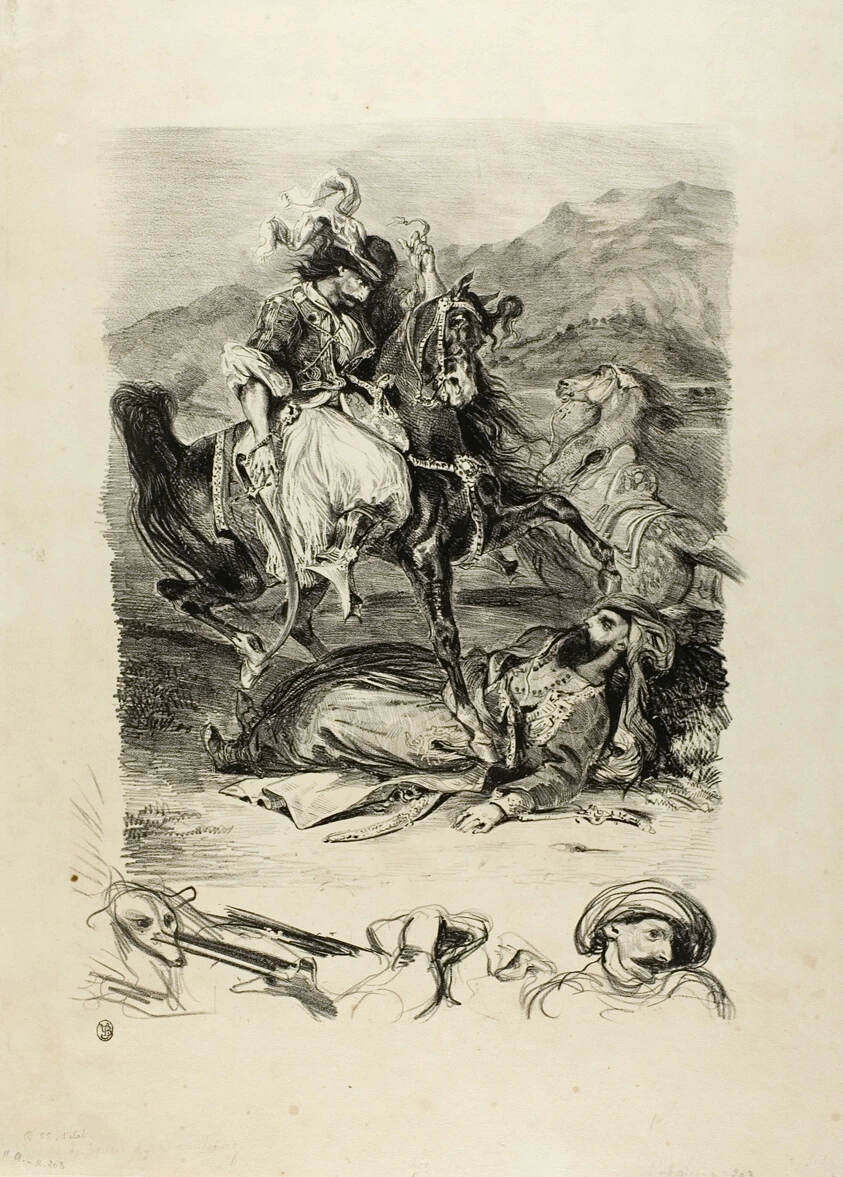
Eugène Delacroix's "Sketches of Algerian Men" (c. 1832) is a pen and brown ink drawing with traces of graphite on tan wove paper, laid down on cream wove paper. This sheet dates from Delacroix's historic journey to Morocco in 1832, a trip that transformed his art and provided subjects for the rest of his career. Delacroix accompanied the French diplomatic mission to Morocco, and the three months he spent there opened his eyes to a world of color, light, and exotic culture that he had only imagined through literature. This drawing shows rapid sketches of Algerian and Moroccan men, their features, costumes, and postures captured with the quick, sensitive line of an artist recording fresh impressions. The pen and brown ink technique is rapid and economical, each stroke conveying essential information about the subject. The traces of graphite suggest an initial underdrawing that the pen then developed. These sketches are invaluable documents of Delacroix's North African journey and the raw material from which he would create some of his most celebrated paintings.
Cultural Impact
Delacroix's Moroccan sketches transformed French painting by introducing a new vision of North Africa that was both more authentic and more vividly colorful than the orientalist fantasies that preceded him.
Why It Matters
These rapid sketches of Algerian men, drawn on the spot during Delacroix's transformative Moroccan journey, capture the freshness of direct observation and provided the foundation for his most celebrated orientalist paintings.