Description
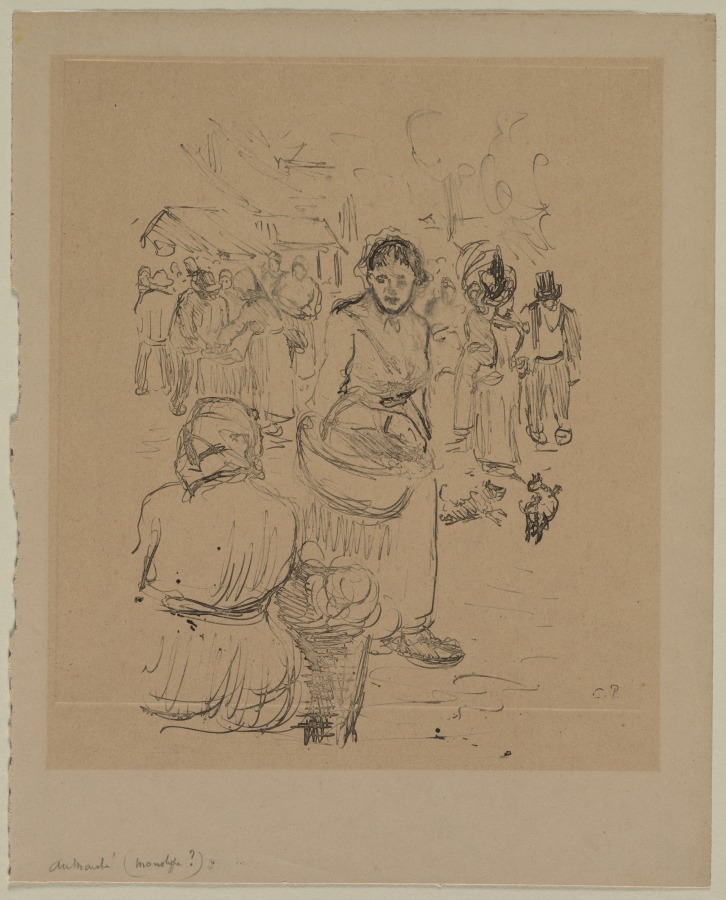
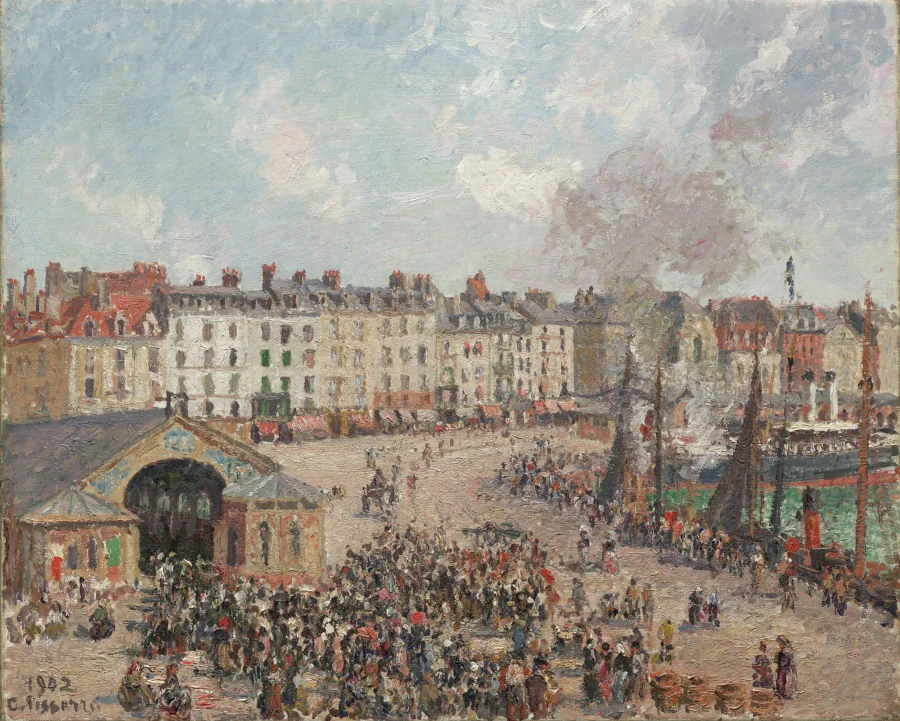
This impressive view of a bustling fish market belongs to a series of paintings that Pissarro made during the summer of 1902 depicting the harbor at Dieppe. Borrowing from the Impressionist method of portraying a modern city from a high vantage point, he enlivened the scene with rich, vibrant colors applied with energetic, broken brushstrokes. Ever concerned with the fleeting effects of atmosphere, Pissarro painted the interpenetration of industrial steam with the clouds in the brilliant, sunlit sky.
Provenance
Possibly Georges Petit [1856-1920] Paris, France; (possibly sold to dealer Duval-Fleury, Paris, France, February 14, 1918) (1918); Wilhelm Hansen [1868-1936] Copenhagen, Denmark, sold to Baron Kojiro Matsudata (1918–1923); Baron Kojiro Matsukata [1865–1950] Kobe, Japan, sold to the 15th Bank of Japan (1923–1927); The 15th Bank, Tokyo, Japan (1927–1928); Kyuzaemon Wada [1890–1968] Osaka, Japan (after 1928–before 1971); (Fujikawa Galleries, Tokyo, Japan, sold to Private Collection) (1971–1974); (sold at Sotheby’s, New York, NY, November 5, 2003, lot 5) (2003); (Acquavella Galleries, New York, NY, sold to Nancy F. and Joseph P. Keithley) (2004); Nancy F. and Joseph P. Keithley, Cleveland, OH, given to the Cleveland Museum of Art (2004–2020); The Cleveland Museum of Art, Cleveland, OH (2020–)
Accession Number
2020.113
Medium
oil on canvas
Dimensions
Unframed: 66 x 81.3 cm (26 x 32 in.)
Classification
Painting
Credit Line
Nancy F. and Joseph P. Keithley Collection Gift
Tags
Painting Early Modern (1901–1950) Oil Painting Canvas French Color: Brown
Background & Context
Background Story
Fishmarket (1902) belongs to Pissarro's late urban series, depicting the commercial activity of a fish market—from the Dieppe harbor or a Paris market hall. The painting's date, 1902, just a year before Pissarro's death, finds the elderly artist still working with remarkable energy and exploring new subjects. The fishmarket—with its commercial activity, its distinctive architecture (often open-sided structures where fish were displayed on ice), and the crowd of buyers, sellers, and workers—provided Pissarro with an urban subject that combined genre observation with architectural and atmospheric effects. Pissarro's treatment likely emphasizes the market's visual character—the displays of fish, the figures of vendors and customers, and the particular quality of light in market halls—rather than the social conditions of the fish trade. The painting's commercial subject reflects Pissarro's sustained interest in economic activity—fishing, farming, and trade—as subjects worthy of artistic attention. His democratic vision extended to commercial spaces: the fishmarket, where people of all classes gathered to buy food, was a social environment as complex and significant as any salon or garden party. The year 1902 also places this during Pissarro's final period, when he was painting with an urgency that reflected both his declining health and his determination to complete his artistic project.
Cultural Impact
Pissarro's market paintings influenced how commercial spaces were represented in Impressionist art, documenting the economic activity that sustained urban life. The paintings influenced later social realist painters who similarly found subjects in markets and commercial spaces. The fishmarket subject influenced how the French fishing industry's distribution network was represented, connecting maritime production to urban consumption.
Why It Matters
This painting matters because it demonstrates Pissarro's lifelong commitment to representing economic activity—fishing, farming, and trade—as worthy artistic subjects. The fishmarket, where the fishing industry's production reached the urban consumer, represents the entire economic chain that Pissarro's art documented from production to consumption, arguing that commercial activity is as significant as leisure in understanding modern life.