Description
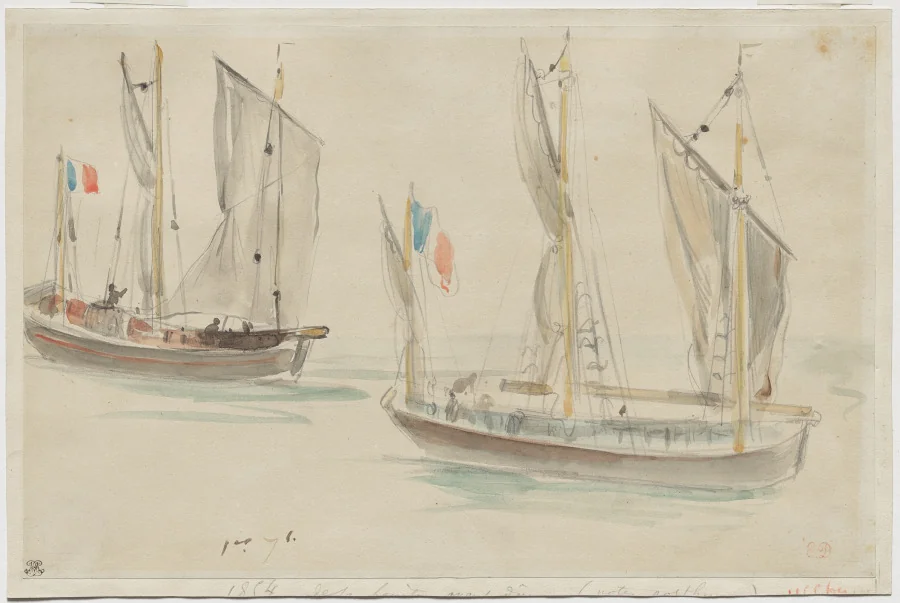
In this late drawing, Eugène Delacroix used spare layers of watercolor to record two large boats floating in a harbor, contrasting the bright tones of the French flags flying on both with the subdued hues of the water surrounding them. The artist recorded the scene during one of five stays in Dieppe, a coastal town that became a popular vacation destination after it was connected to Paris by train in 1848. Delacroix was passionate about depicting the sea and its environs and created numerous variations of this subject over the course of about a decade.
Provenance
Studio of the artist [1798-1863] (1854-1864); (his posthumous sale, Hôtel Drouot, Paris, February 22-27, 1864, probably part of no. 600 [“Études faites dans le port de Dieppe et dans les environs: vagues, soleils couchants, etc. (1852, 1854 et 1855)”]) (1864); Marcel Louis Guérin [1873-1948] (?-?); (M. Knoedler & Co., New York, NY) (?-before 1976); (sale, Sotheby Parke Bernet, New York, May 14, 1976, no. 285, sold to Mrs. Muriel Butkin, Shaker Heights, OH) (1976); Mrs. Muriel Butkin, Shaker Heights, OH, bequeathed to the Cleveland Museum of Art (1976-2008); Cleveland Museum of Art, Cleveland, OH (2021-)
Accession Number
2021.108
Medium
watercolor and pencil on paper laid down on board
Dimensions
Image: 22.5 x 34.6 cm (8 7/8 x 13 5/8 in.); Sheet: 22.5 x 34.6 cm (8 7/8 x 13 5/8 in.); Mounted: 24 x 36 cm (9 7/16 x 14 3/16 in.)
Classification
Drawing
Credit Line
Bequest of Muriel Butkin
Tags
Drawing Impressionist & Modern (1851–1900) Watercolor Graphite & Pencil Paper Board French Color: White
Background & Context
Background Story
Eugène Delacroix (1798-1863) was the leading painter of the French Romantic movement, known for his dramatic history paintings, Orientalist subjects, and vigorous brushwork. Two Boats at the Harbor of Dieppe from 1854 is a watercolor study of boats in the harbor of Dieppe, the port city in Normandy where Delacroix spent time in the 1850s. The watercolor medium allows a spontaneity and directness that the more deliberate oil paintings sometimes lack, and the harbor subject allows Delacroix to exercise his talent for marine painting in a more relaxed and observational mode than his dramatic seascapes.
Cultural Impact
Delacroix's watercolor studies of Dieppe are important documents in the history of Romantic watercolor because they show the master of French Romantic painting working in a medium that rewards spontaneity and direct observation. Two Boats at the Harbor of Dieppe captures the specific light and atmosphere of the Norman port with a directness that the more ambitious oil paintings cannot match.
Why It Matters
Two Boats at the Harbor of Dieppe is Delacroix's watercolor at its most direct: boats in the Norman port rendered with a spontaneity and observational freshness that the more ambitious oil paintings sometimes lack. The 1854 study captures the specific light and atmosphere of Dieppe harbor with the immediacy that only watercolor can provide.