Description
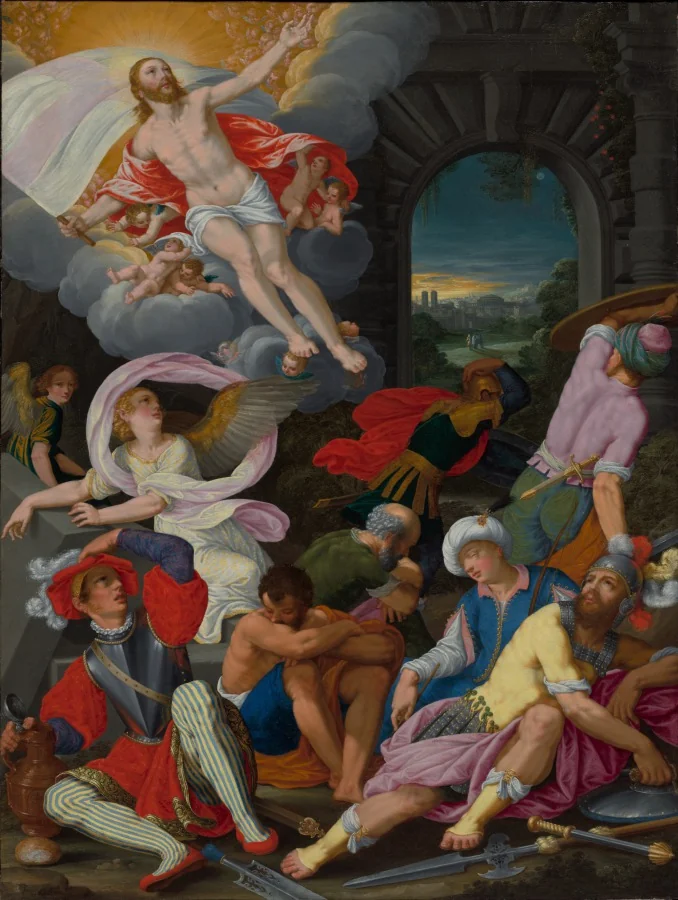
According to Christian belief, three days after his death by crucifixion, Christ rose from the dead and ascended into heaven. König’s interpretation of this traditional theme employs vivid colors and explosive poses to express the drama of the event. Meticulous brushwork delineates exquisite details, and draws attention to the luminous landscape and the three holy women hastening towards Christ’s vacant tomb.
Provenance
Count Joseph Franz Anton Wunibald Andreas Saturnin, Truchseß [Steward] zu Waldburg-Zeil-Wurzach [1748–1813], Cologne, Wurzach and Vienna by 1796, until 1813 (until 1813); Among 81 paintings purchased from the Truchsessian collection by Ludwig I, Landgrave of Hesse-Darmstadt and Grand Duke of Hesse and by Rhine [1753–1830] (between 1814 and 1820); Presented by Ludwig I to the Großherzogliches Museum, Darmstadt, 1820 (1820); Deaccessioned from the Großherzogliches Museum, Darmstadt, between 1830 and 1854 (1830-1854); Collection Wilhelm Kreis [1873–1955], Düsseldorf, probably by the 1920s (by 1920s); Bequeathed by Wilhelm Kreis to his nephew and godson, Helmut Arntz [1912–2007] (1955-2007); By descent to his son, Joachim Arntz, by whom sold (2007-2012); (Lempertz, Cologne, November 17, 2012, no. 1126, sold to a consortium of dealers including Konrad Bernheimer [Colnaghi] and Otto Naumann) (2012); (Colnaghi, London / Bernheimer Fine Old Masters, Munich [2014]) (2012-2014)
Accession Number
2017.192
Medium
oil on copper
Dimensions
Unframed: 61 x 46 cm (24 x 18 1/8 in.)
Classification
Painting
Credit Line
Leonard C. Hanna Jr. Fund
Tags
Painting Baroque (1600–1750) Oil Painting Copper German Color: Orange Color: Brown
Background & Context
Background Story
Johann Konig (c. 1585-1642) was a German painter known for his small-scale religious paintings on copper in the precise, colorful manner that distinguishes the best German cabinet painting of the early 17th century. The Resurrection of Christ from 1622 depicts the biblical subject in the precise, colorful manner that Konig developed from the Netherlandish cabinet painting tradition. The copper panel support allows for the precise detail and brilliant color that distinguish Konig's best work from the more broadly painted German religious painting of the period.
Cultural Impact
The Resurrection of Christ is important in the history of German painting because it demonstrates the precise, colorful cabinet painting manner that German painters developed from the Netherlandish tradition. Konig's small-scale religious painting on copper shows the German cabinet painting tradition at its most precise and colorful—a tradition that adapted the Netherlandish cabinet manner to German religious subjects with characteristic precision and brilliance.
Why It Matters
The Resurrection of Christ is Konig's precise German cabinet painting: the biblical subject rendered on copper in the precise, colorful manner that distinguishes the best German cabinet painting of the early 17th century. The 1622 painting shows the Netherlandish cabinet manner adapted to German religious subjects with characteristic precision and brilliance.
![Saint Bernard and Saint Catherine of Alexandria with the Virgin of the Annunciation [right panel]](https://api.nga.gov/iiif/e6890364-4d99-4684-a62b-5060ee3c3446/full/400,/0/default.jpg)