Description
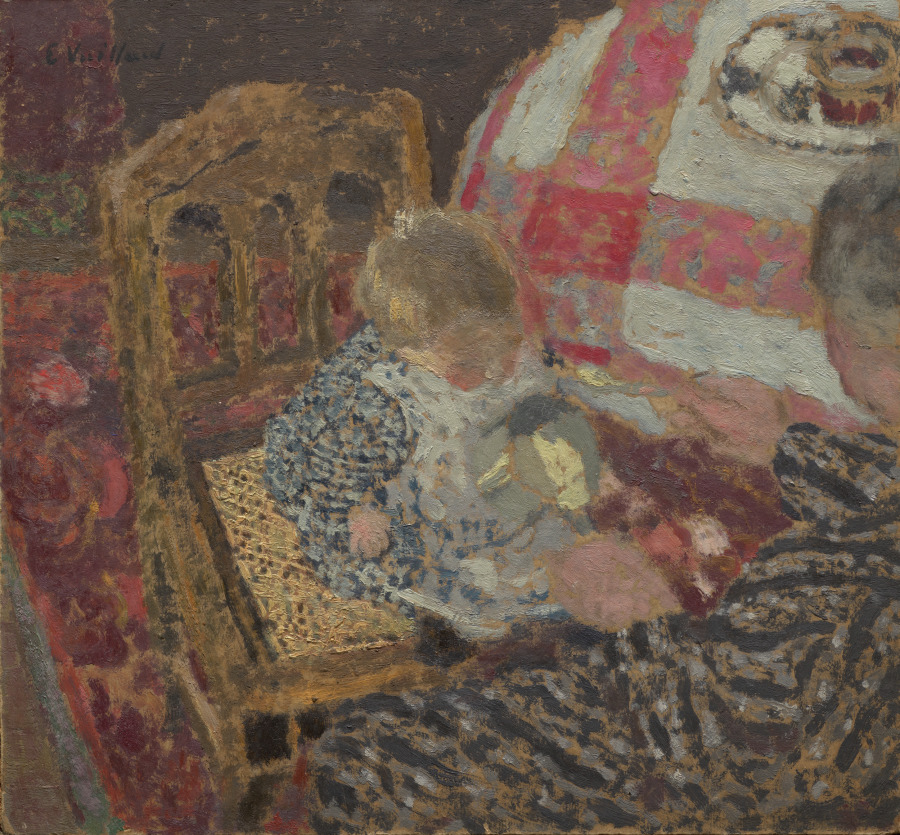
In this quiet scene, the laundress concentrates on the garment before her as a sliver of morning light illuminates the side of her face and her cup. Vuillard, an artist concerned with domestic life, often portrayed women at work. Many members of his family worked with textiles, as reflected in the artist's focus on laundresses, seamstresses, and patterned clothing.
Provenance
Alfred Athis Natanson [1873-1932], Paris France; passed to his daughter, Annette Charbonnier [1901–2002], Paris, France; passed to her son, Jean Philippe Charbonnier [1921–2004], Paris, France; (Galerie Hopkins, Paris, France, April 26, 2013, sold to Nancy F. and Joseph P. Keithley) (2013); Nancy F. and Joseph P. Keithley, Cleveland, OH, given to the Cleveland Museum of Art (2013–2020); The Cleveland Museum of Art, Cleveland, OH (2020–)
Accession Number
2020.119
Medium
oil on board
Dimensions
Unframed: 21.4 x 25.4 cm (8 7/16 x 10 in.)
Classification
Painting
Credit Line
Nancy F. and Joseph P. Keithley Collection Gift
Tags
Painting Impressionist & Modern (1851–1900) Oil Painting Board French Color: Yellow
Background & Context
Background Story
Woman Ironing, painted in 1892, belongs to Vuillard early Intimist period and depicts a domestic interior in which a woman irons clothes, her figure absorbed into the patterned environment of the room. The painting exemplifies the Nabi aesthetic of the domestic interior as a site of formal experimentation.
Vuillard and his fellow Nabis - Bonnard, Denis, Roussel, and Serrusier - sought to create a modern decorative art that would bring painting out of the museum and into daily life. Vuillard contribution to this project was his discovery that the domestic interior - the most private, most enclosed, most thoroughly lived-in space in modern life - could produce paintings of the highest formal ambition, comparable in their decorative sophistication to the greatest tapestries and murals.
The painting most radical feature is its treatment of pattern. The wallpaper, the floor, and the woman dress all are covered with repeating patterns that Vuillard renders with obsessive precision, creating a visual field of such complexity that the human figure becomes one pattern among many. The woman who irons is not the subject of the painting but an element in its decorative scheme - a pattern of movement within a larger pattern of stillness. This absorption of the figure into the surrounding pattern is Vuillard signature and the quality that distinguishes his Intimism from the more figure-centered domestic painting of the Dutch tradition.
Cultural Impact
Vuillard Intimist paintings established the domestic interior as a major site of modernist experimentation and influenced the entire tradition of interior painting in the 20th century, from Matisse to Hopper. His demonstration that pattern and decoration were as ambitious as any other formal concern contributed to the Pattern and Decoration movement of the 1970s.
Why It Matters
Woman Ironing captures Vuillard most revolutionary insight: that a room is not a container for life but a participant in it. The patterned walls, the patterned dress, and the woman who irons are all elements of a single decorative scheme - a total environment in which the boundary between the person and the room, the figure and the ground, has been dissolved.