Accession Number
2016.6
Medium
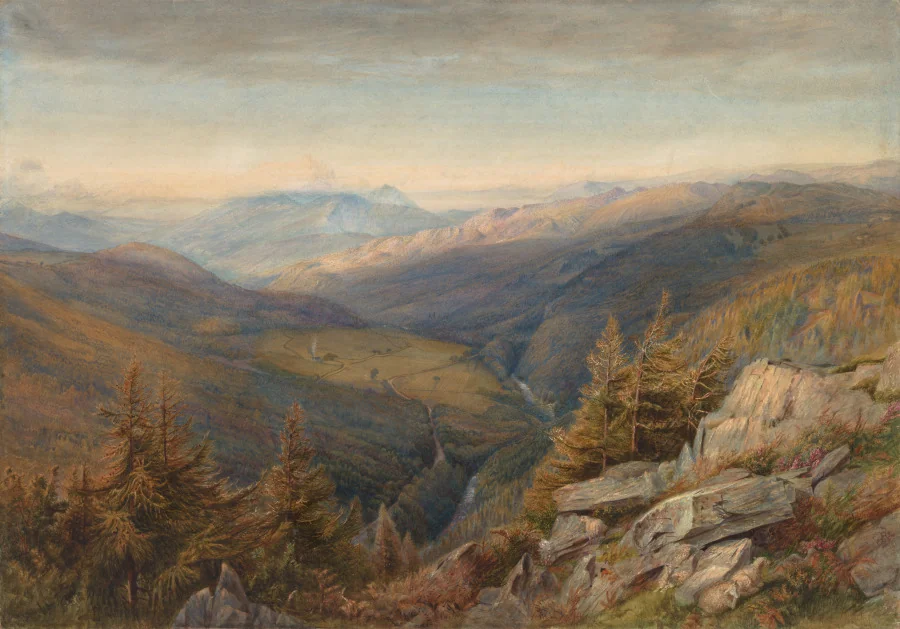
Watercolor with graphite and touches of gouache and scraping on paper
Dimensions
Sheet: 52.8 x 75.8 cm (20 13/16 x 29 13/16 in.)
Classification
Drawing
Credit Line
Dudley P. Allen Fund
Tags
Drawing Impressionist & Modern (1851–1900) Watercolor Graphite & Pencil Gouache Paper American Color: Gold
Background & Context
Background Story
Robert J. Pattison's Mountain View, painted between 1862 and 1867, belongs to the great tradition of American mountain landscape painting that defined the mid-19th century. Pattison was a Philadelphia-based artist who, like many of his contemporaries, turned to the mountain scenery of the northeastern United States for subjects that combined grandeur with the spiritual resonance Americans attached to their natural landscape. The period of 1862-1867 spans some of the most turbulent years of the Civil War, and landscape painting during this era served complex functions: it offered a vision of enduring natural beauty amid national crisis, and it reinforced the idea that America's mountains, forests, and rivers were the true monuments of the nation. Mountain views in the Hudson River School tradition typically employed a carefully structured composition in which a foreground of trees or rocky outcroppings framed a middle distance of water or valley, leading the eye to distant peaks bathed in atmospheric light. Pattison's view likely follows this compositional logic, presenting the mountain with the clarity and reverence characteristic of the American landscape tradition at its most accomplished. Philadelphia, where Pattison worked, had a strong landscape painting community that included the older generation of the Düsseldorf-trained artists and the younger painters who were absorbing the influence of the Barbizon School. Pattison's Mountain View stands as a document of the American belief, articulated most powerfully by the Hudson River School, that the nation's highest artistic and spiritual calling was the faithful depiction of its magnificent natural scenery.
Cultural Impact
Mountain landscapes like Pattison's were central to the formation of American cultural identity during the Civil War era. They provided images of national endurance and natural grandeur that helped sustain the idea of an indivisible American landscape even as the nation was being torn apart by conflict.
Why It Matters
This painting exemplifies how American landscape art served as a vehicle for national identity during the Civil War, offering visions of permanence and majesty in a time of crisis.