Description
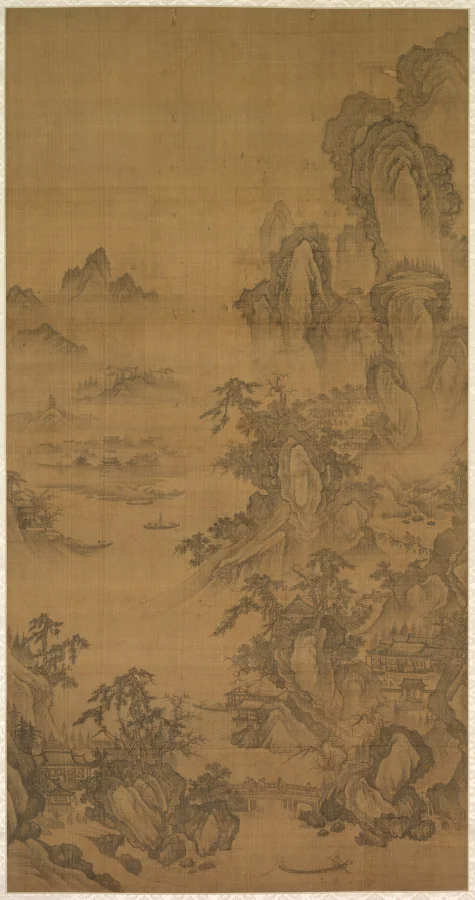
This painting depicts several vignettes of the scholar-hermit’s various activities. In the lower left corner, the scholar-hermit is portrayed welcoming his guest in the courtyard. In the middle section on the lower bottom, the scholar and his guest are shown encountering another traveler on the bridge and exchanging their greetings. After crossing the bridge, the scholar visits a friend who lives in a compound of multiple buildings. The two friends decide to take a short walk. Both appear in a terraced cliff, enjoying a mountain vista and the fragrance of an old pine tree carried by the gentle wind. The scholar continues his journey with his two servants. They are portrayed crossing a winding wooden bridge. Right beyond the colossal rocky mountain, a panoramic view to a bustling market place unfolds, suggesting that it may be the place where the scholar-hermit’s entourage would visit. Perhaps the scholar need to buy items such as books, rolls of papers, and brushes, all essential to scholarly life. Toward the upper left corner, another group of travelers is landing on the river bank that leads to the city gate; they may be headed to the multistoried Buddhist stupa nestled on the top of the mountains.
Provenance
(Andreas Leisinger, Tokyo, Japan, sold to George Gund III); George Gund III [1937–2013], bequest to the Cleveland Museum of Art (?–2015); The Cleveland Museum of Art, Cleveland, OH (2015–)
Accession Number
2015.517
Medium
Hanging scroll; ink on silk
Dimensions
Painting: 115.3 x 60 cm (45 3/8 x 23 5/8 in.); Overall: 179 x 70.7 cm (70 1/2 x 27 13/16 in.); Overall with knobs and cord: 181.8 x 77 cm (71 9/16 x 30 5/16 in.)
Classification
Painting
Credit Line
Gift from the Collection of George Gund III
Tags
Painting Renaissance (1400–1599) Ink Silk Painting Color: Gold
Background & Context
Background Story
Mountain Market, Clear with Rising Mist, created in the early 1500s during the Ming dynasty, depicts a bustling market scene set within a landscape of towering mountains and rising mist. The painting belongs to the tradition of Chinese landscape painting that reached its fullest development during the Song and Ming dynasties, in which human activity is integrated into a vision of nature as both a physical reality and a philosophical concept.
The painting subject - a market in the mountains - is representative of the Chinese landscape tradition interest in the relationship between human society and the natural world. Where Western landscape painting typically positions the viewer outside the landscape, looking at it as scenery, Chinese landscape painting positions the viewer within the landscape, participating in its processes and sharing its atmosphere.
The painting most distinctive quality is its treatment of mist, which serves both as a natural phenomenon and as a compositional device. The rising mist obscures the lower slopes of the mountains, creating a sense of infinite depth that the Chinese call kong (emptiness) - a space that is not empty but full of potential, where the visible and the invisible coexist. The market, with its tiny figures and its buildings, occupies the visible foreground, while the mountains above disappear into the mist, suggesting a world that extends beyond the reach of human vision.
Cultural Impact
Chinese mountain market paintings represent one of the highest achievements of East Asian landscape art and influenced the entire tradition of landscape painting in Korea and Japan. Their integration of human activity into a landscape of philosophical depth created a model of the human relationship to nature that remains relevant to environmental thought today.
Why It Matters
This painting captures the most fundamental principle of Chinese landscape art: that mountains and mist are not scenery but philosophy. The market, with its human bustle, exists within a landscape that is ultimately mysterious - and the painting suggests that the most profound truths about human life are found not in the marketplace but in the mist above it.