Description
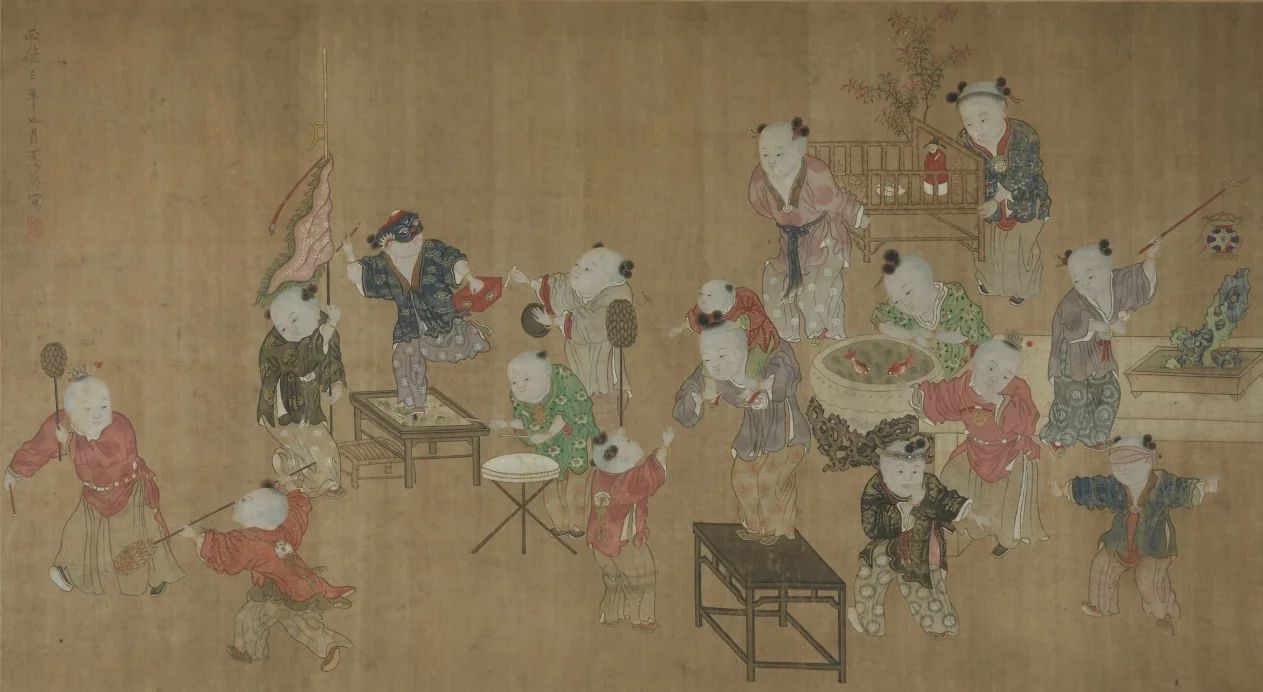
Sixteen children engage in scholarly, religious, and military activities, representing the popular “one hundred boys” theme expressing the wish for abundant, successful male offspring. Such paintings conveying auspicious wishes were often displayed during the New Year festival season.
Two older boys wear small crowns with red tassels. Another child with a mask holds a brush in one hand, a rice measure in the other. He stands on a low table imitating Kuixing, the God of Examinations and servant to the God of Literature.
Two older boys wear small crowns with red tassels. Another child with a mask holds a brush in one hand, a rice measure in the other. He stands on a low table imitating Kuixing, the God of Examinations and servant to the God of Literature.
Provenance
Charles L. Freer [1854–1919], Detroit, MI, given to the Cleveland Museum of Art (?-1915); The Cleveland Museum of Art, Cleveland, OH (1915-)
Accession Number
1915.110
Medium
hanging scroll; ink and color on silk
Dimensions
Painting: 62.5 x 113.7 cm (24 5/8 x 44 3/4 in.); Overall with knobs: 214 x 137 cm (84 1/4 x 53 15/16 in.)
Classification
Painting
Credit Line
Gift of Charles L. Freer
Tags
Painting Renaissance (1400–1599) Ink Silk Painting Chinese Color: Brown
Background & Context
Background Story
Xia Kui (active c. 1475-1525) was a Chinese painter of the Ming dynasty known for his figure paintings and genre subjects in the meticulous manner (gongbi) that distinguishes the best Ming court painting. Children at Play from 1508 depicts children playing in the meticulous, colorful manner that distinguishes Xia Kui's best figure painting from the more spontaneous literati painting of the Ming period. The painting is a rare surviving work by an artist known for only a handful of paintings, and the 1508 date makes it one of the earliest dated works by Xia Kui.
Cultural Impact
Children at Play is important in the history of Chinese figure painting because it demonstrates the meticulous court manner (gongbi) that distinguishes Ming court painting from the more spontaneous literati painting. Xia Kui's meticulous, colorful treatment of children playing represents the court painting tradition at its most charming—a tradition that is often overshadowed by the more prestigious literati tradition but that produced some of the most accomplished figure painting of the Ming period.
Why It Matters
Children at Play is Xia Kui's meticulous court painting: children playing rendered in the colorful, detailed gongbi manner that distinguishes Ming court painting from the more spontaneous literati tradition. The 1508 painting is a rare surviving work by a painter known for only a handful of paintings, representing the court tradition at its most charming.

![Saint Bernard and Saint Catherine of Alexandria with the Virgin of the Annunciation [right panel]](https://api.nga.gov/iiif/e6890364-4d99-4684-a62b-5060ee3c3446/full/400,/0/default.jpg)