Description
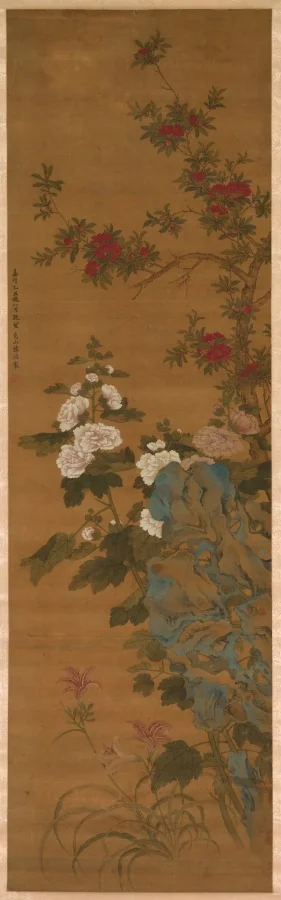
Here, the painter uses delicate brushwork and vivid colors to depict an early summer scene of three kinds of flowers growing beside a garden rock: From top to bottom we see flowering pomegranate, then peonies, and lilies below. Like the peony, which conveys wishes for wealth and prosperity, the pomegranate flower, here in festive red color turning soon into fruit with many seeds, is associated with the wish for many sons. The lily, in Chinese "baihe," is a homophone with the pun "togetherness for a hundred years," expressing wishes for harmony and unity. The scroll would have made a suitable gift to married women.
Provenance
Charles L. Freer [1854-1919], Detroit, MI, given to the Cleveland Museum of Art (?-1915); The Cleveland Museum of Art, Cleveland, OH (1915-)
Accession Number
1915.116
Medium
hanging scroll, color on silk
Dimensions
Overall: 162.6 x 48.6 cm (64 x 19 1/8 in.)
Classification
Painting
Credit Line
Gift of Charles L. Freer
Tags
Painting Medieval (500–1399) Silk Painting Color: Gold
Background & Context
Background Story
Flowers and Rocks from the Ming dynasty (1368-1644) is an anonymous Chinese painting depicting flowers and rocks in the ink and color manner that distinguishes the Chinese bird-and-flower painting tradition. The subject of flowers and rocks—combining the delicate beauty of flowers with the rugged strength of rocks—is one of the most traditional in Chinese painting, expressing the philosophical contrast between yin (the soft, the floral) and yang (the hard, the mineral). The broad date range of the Ming dynasty makes precise dating difficult, but the painting demonstrates the bird-and-flower tradition at its most characteristic.
Cultural Impact
Flowers and Rocks is an example of the bird-and-flower tradition that is one of the most important subjects in Chinese painting. The combination of flowers and rocks—expressing the philosophical contrast between yin and yang—is one of the most traditional in Chinese painting, and this anonymous Ming dynasty painting shows the tradition in its most characteristic form, combining the delicate beauty of flowers with the rugged strength of rocks.
Why It Matters
Flowers and Rocks is an anonymous Ming dynasty bird-and-flower painting: the traditional subject of flowers and rocks that expresses the philosophical contrast between yin and yang. The painting shows one of the most traditional subjects in Chinese painting—delicate flowers contrasting with rugged rocks.