Description
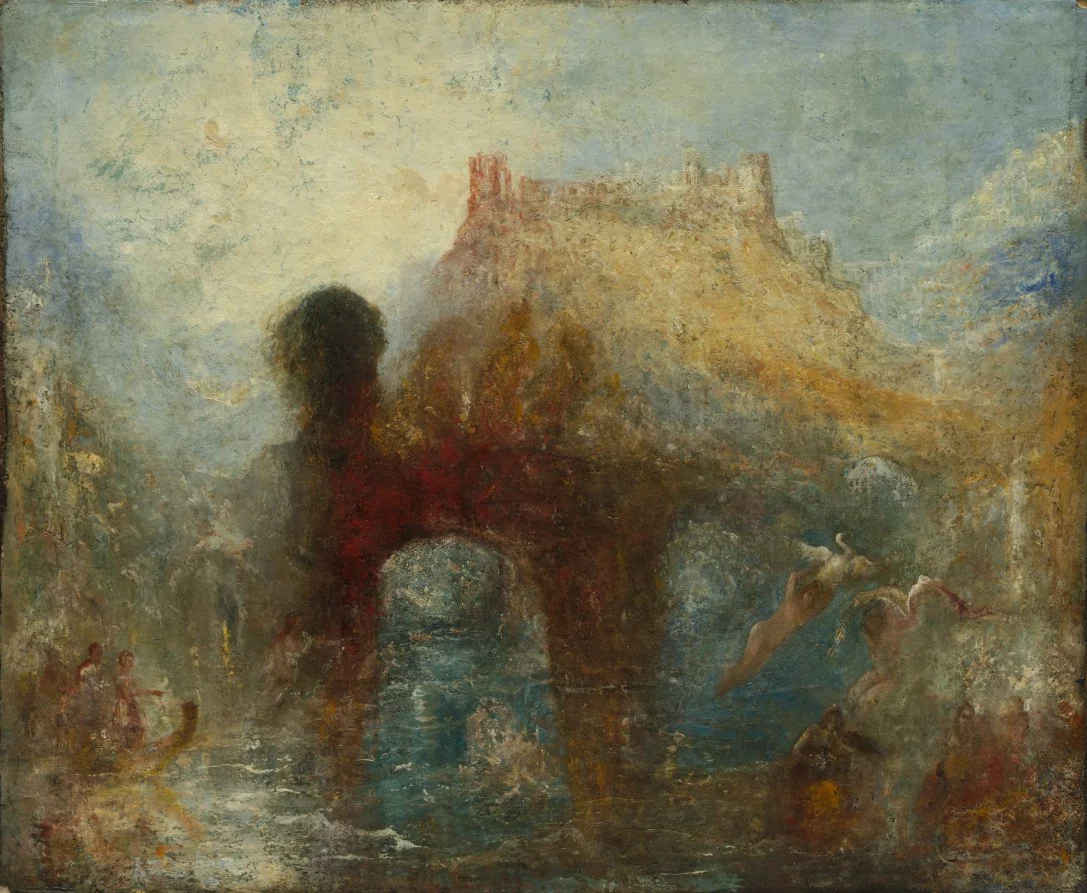
This work is a reduced copy of a painting first exhibited by Turner at the British Institution in 1846 that passed, with the rest of his immense bequest to the nation, into the collections of the National Gallery and finally, in 1954, the Tate Gallery. Several lines from Shakespeare's A Midsummer Night's Dream and Turner's manuscript poem "Fallacies of Hope" were appended to the title in the British Institution catalogue, but they did little to explicate the nearly unintelligible concoction of fairies and Welsh ruins that make up this composition. Copies of Queen Mab's Cave by anonymous artists are abundant.
Provenance
[]
Accession Number
1916.1036
Medium
oil on fabric
Dimensions
Unframed: 73 x 89.5 cm (28 3/4 x 35 1/4 in.)
Classification
Painting
Credit Line
Gift of Mr. and Mrs. J. H. Wade
Tags
Painting Neoclassical & Romantic (1751–1850) Oil Painting British Color: Yellow
Background & Context
Background Story
Queen Mab's Cave is one of Turner's most extreme late works, a painting so dissolved in light and color that Victorian critics could barely identify a subject. Queen Mab, from Shakespeare's Romeo Mercutio's speech, is the fairy midwife who delivers dreams — and Turner rendered her realm as pure visual delirium. Gold, pink, and white pigments swirl together with barely any recognizable forms. Even by the standards of Turner's late period, this painting is startling in its radicalism.
Cultural Impact
When exhibited in 1846, the painting was ridiculed. Critics called it 'a disaster,' 'a daydream,' and 'the most absurd picture.' But these very qualities — the dissolution of form, the primacy of color and light over narrative — make it a crucial precursor to 20th-century abstraction. Turner was painting the experience of seeing itself, not the things seen.
Why It Matters
Queen Mab's Cave represents the frontier of what painting could be in the 1840s. It would take another sixty years for the art world to catch up. This is Turner's most defiant statement: that painting need not represent reality but can embody pure sensation.