Description
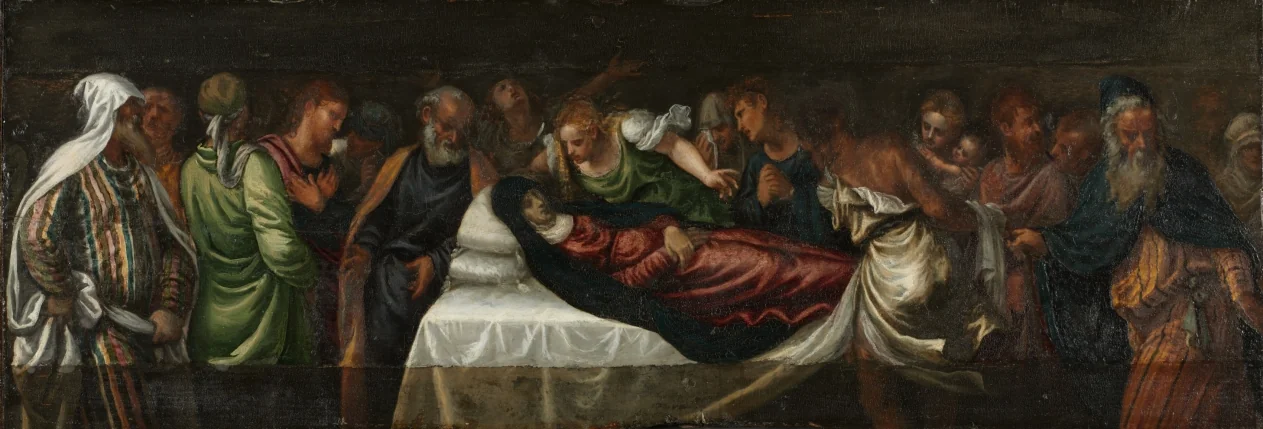
This panel reveals a long history of changes. The initial work was painted on a single slab of wood, with strips left unpainted along the top and bottom. At an unknown time, the panel was probably cut down on the right and left sides, and the two blank strips at the top and bottom were filled in to enlarge the picture, most likely to fit its current, elaborately carved, 18th-century frame. Although these additions must have been initially more convincing, they were painted to match the yellowed and darkened original image, and thus no longer match the original paint. The flat and mismatched handling of the draperies in the lower portion also signal the intervention of a subsequent hand. The painting may have been part of an altarpiece as the predella, a long, horizontal painting along the base. The bottom of this panel exhibits signs of damage from fire and smoke, perhaps from the candles that could have been placed in front of it.
Provenance
Gino Capponi Gallery, Florence;; James Jackson Jarves, 1883;; Mrs. Liberty E. Holden, Cleveland, 1884, by gift to the Cleveland Museum of Art, 1916.; .
Accession Number
1916.797
Medium
oil on wood
Dimensions
Framed: 78.8 x 130.9 cm (31 x 51 9/16 in.); Unframed: 25 x 103.5 cm (9 13/16 x 40 3/4 in.)
Classification
Painting
Credit Line
Holden Collection
Tags
Painting Renaissance (1400–1599) Oil Painting Color: Orange Color: Brown
Background & Context
Background Story
Death of the Virgin from the mid-1500s is an anonymous Netherlandish painting depicting the death of the Virgin Mary in the precise, detailed manner that distinguishes the best Netherlandish religious painting of the mid-16th century. The subject of the Death of the Virgin was one of the most important in Netherlandish religious painting, treated by many of the greatest Netherlandish masters from van Eyck through Bosch, and this anonymous painting maintains the precise, devotional manner of the tradition.
Cultural Impact
Death of the Virgin is important in the context of Netherlandish religious painting because it demonstrates the precise, devotional manner that the tradition maintained throughout the 16th century. The anonymous painting shows that the Netherlandish tradition of precise, devotional religious painting was not limited to known masters but was practiced at a high level of accomplishment by anonymous workshop painters throughout the period.
Why It Matters
Death of the Virgin is anonymous Netherlandish religious painting: the death of the Virgin Mary rendered in the precise, devotional manner that the tradition maintained throughout the mid-16th century. The painting shows the Netherlandish tradition of religious painting practiced at a high level of accomplishment by anonymous workshop painters.