Description
Throughout his long career, Edmondson stubbornly resisted modernist styles and proudly proclaimed himself a traditionalist. He felt that artists should paint what they see, and once declared, "When painting a portrait, I do not indulge in this ‘painting of the soul’ stuff. When some artists fail to get a likeness of a person they say they have not tried to paint him, but have painted his soul." The sitter in The Blue Feather was Edmondson's student, Caroline Mytinger, who often modeled for him. Later a portraitist in her own right, she traveled to New Guinea and the Solomon Islands to record its indigenous people.
Provenance
[]
Accession Number
1917.400
Medium
oil on canvas
Dimensions
Framed: 107.3 x 112.4 x 5.8 cm (42 1/4 x 44 1/4 x 2 5/16 in.); Unframed: 70.5 x 75.6 cm (27 3/4 x 29 3/4 in.)
Classification
Painting
Credit Line
Gift of Morris Glauber
Tags
Painting Early Modern (1901–1950) Oil Painting Canvas American Color: Brown
Background & Context
Background Story
William J. Edmondson's The Blue Feather, painted in 1917, is a still life or genre painting whose title suggests a subject of decorative elegance. The blue feather as an artistic motif carries rich associations: in the language of still life, feathers speak of the transience of beauty, the exoticism of distant creatures, and the delicate artifice of fashion. In the context of 1917, with the United States entering World War I, a painting focused on aesthetic refinement and intimate beauty represents both an assertion of art's enduring value and, perhaps, a deliberate retreat from the turmoil of current events. Edmondson was an American painter working in a period when still life and genre subjects were experiencing a revival of interest after decades in which landscape and portraiture had dominated American exhibition spaces. The choice of a blue feather as a subject suggests an artist with a decorative sensibility, attentive to the play of color against neutral backgrounds and the textural complexity of a natural object removed from its original context. The year 1917 also saw the Armory Show's revolutionary impact settling into American art, and painters working in still life and intimate genres were navigating between traditional approaches and the new possibilities that modernism had opened. Whether The Blue Feather is a pure still life or incorporates a figure wearing the eponymous feather, the title places the accent on a single vivid detail, suggesting a composition organized around a focal point of intense color. This approach to composition, in which a small but striking element anchors the entire image, reflects both traditional academic practice and the emerging modernist interest in selective focus and visual emphasis.
Cultural Impact
Still life paintings featuring objects like feathers demonstrate the American art world's continuing investment in intimate, carefully composed subjects even during periods of national crisis. Works like The Blue Feather represent the endurance of decorative and contemplative values in American painting alongside the century's upheavals.
Why It Matters
This painting demonstrates how American artists found meaning in intimate, carefully composed subjects during a period of national crisis, asserting art's capacity for beauty and reflection amid historical turmoil.

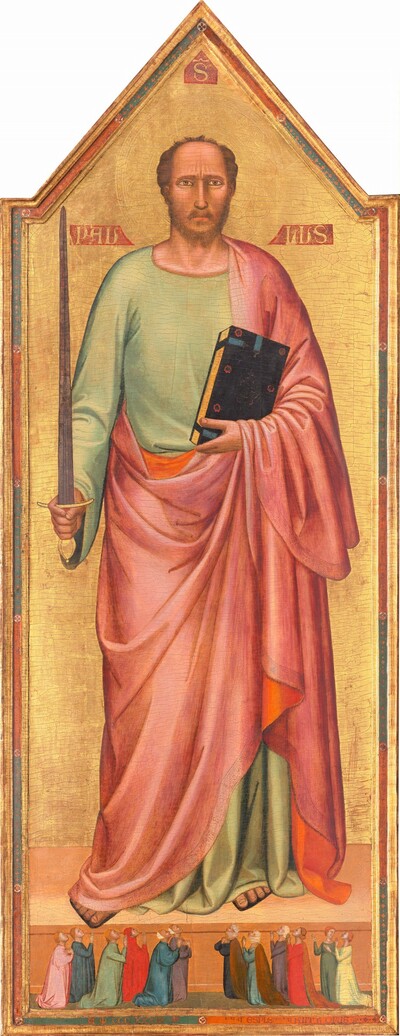
![Saint Bernard and Saint Catherine of Alexandria with the Virgin of the Annunciation [right panel]](https://api.nga.gov/iiif/e6890364-4d99-4684-a62b-5060ee3c3446/full/400,/0/default.jpg)