Description
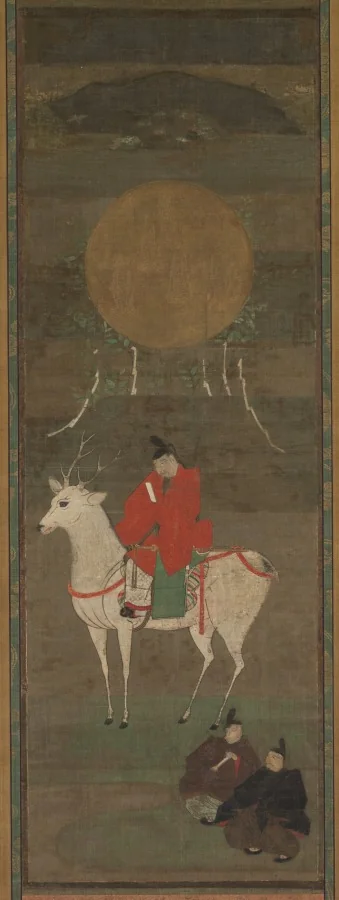
The kami Takemikazuchi from Kashima (in present-day Ibaraki Prefecture) departs on a white deer for Mount Mikasa in Nara, where he takes up residence. The five Kasuga kami are presented within a golden circle supported by the branches of a sakaki tree, from which trail five white paper streamers—indicating the purity and sacredness of the five shrine halls of the complex—as well as blossoming wisteria vines, a symbol of the Fujiwara family. The two figures walking along near the stag’s back legs are Nakatomi no Tokifū and his younger brother Hidetsura, who have followed Takemikazuchi and become priests of Kasuga Taisha.
Provenance
Purchased with funds from Worcester R. Warner [1846–1929] and Cornelia Blakemore Warner [1858–1947] by Langdon Warner [1881–1955], as agent of the Cleveland Museum of Art (?–1917); The Cleveland Museum of Art, Cleveland, OH (1917–)
Accession Number
1917.93
Medium
hanging scroll; ink and color on silk
Dimensions
Overall: 212.7 x 63.3 cm (83 3/4 x 24 15/16 in.); Including mounting: 119.4 x 41 cm (47 x 16 1/8 in.)
Classification
Painting
Credit Line
The Worcester R. Warner Collection
Tags
Painting Medieval (500–1399) Ink Silk Painting Color: Brown
Background & Context
Background Story
Departure from Kashima from the 1336-92 Nanboku-cho period is an anonymous Japanese painting depicting a departure from the Kashima shrine, one of the most important Shinto shrines in Japan. The 1336-92 date places this in the Nanboku-cho period (1336-1392), when Japan was divided between two rival imperial courts, and paintings of shrine and temple subjects were important vehicles for the expression of religious devotion and courtly culture. The departure subject—showing a figure leaving a shrine after worship—was a popular subject in Japanese painting, combining religious devotion with the narrative interest of travel and departure.
Cultural Impact
Departure from Kashima is important in the history of Japanese painting because it demonstrates the shrine and temple painting tradition that was one of the most important subjects in Japanese art during the Nanboku-cho period. The 1336-92 painting shows how religious devotion and courtly culture were combined in Japanese painting during a period of political division, when shrine and temple subjects served as important vehicles for the expression of both religious feeling and cultural identity.
Why It Matters
Departure from Kashima is an anonymous Nanboku-cho period painting: a departure from one of Japan's most important Shinto shrines rendered in the narrative religious tradition of 14th-century Japanese painting. The 1336-92 painting shows the combination of religious devotion and courtly culture during a period of political division.