Description
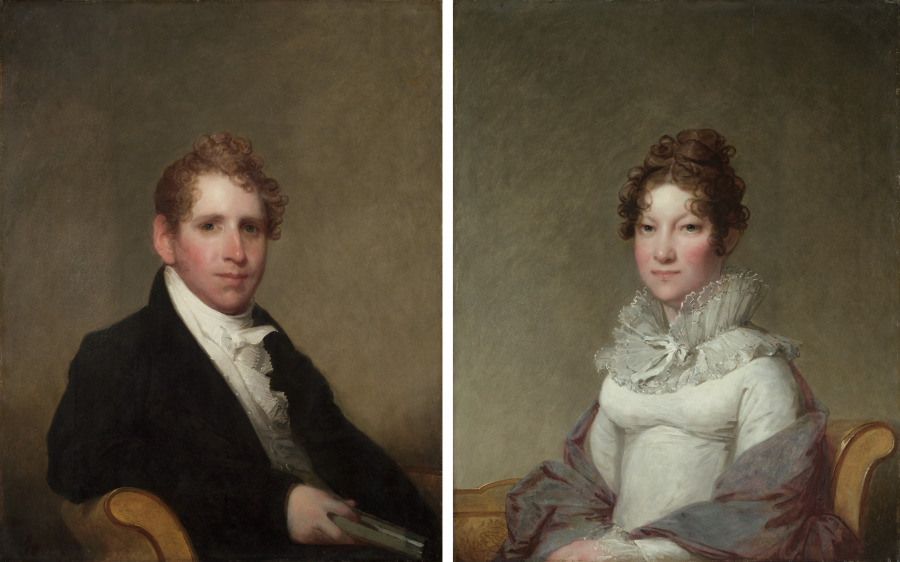
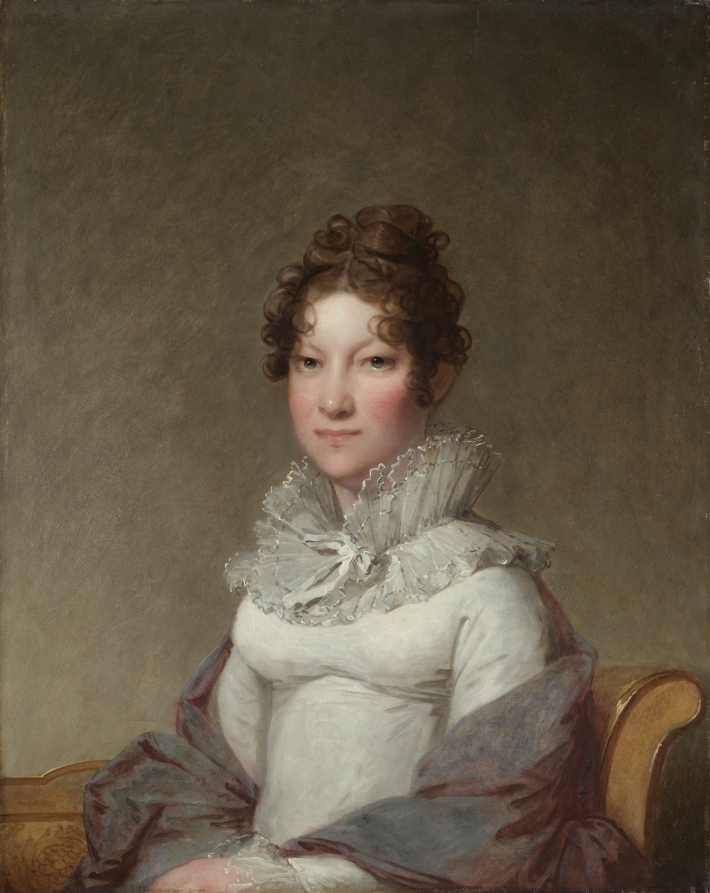
The sitter’s high-waisted dress, pearl necklace, and elegant hairstyle of cascading ringlets reflect the height of fashion around 1800. Her gaze is assured: her chin is tilted upward but her eyes peer down with confidence. Mason’s husband was a prosperous lawyer, an influential figure in President Thomas Jefferson’s administration, and a plantation owner in Maryland. According to an inventory from 1807, the couple enslaved approximately 185 people, ranging from the newborn Abraham to 79-year-old Rachel. The family’s wealth afforded Mason the opportunity to be painted by Gilbert Stuart, a much sought-after portraitist.
Provenance
The Cleveland Museum of Art, Cleveland, Ohio (1921-); (Frank W. Bayley, Boston, sold to the Cleveland Museum of Art) (1921); Louisa Mason Terry [1844-1921], Washington, DC, consigned to Frank W. Bayley for sale1 (1899-1921); Margaret Augusta Cowan Mason [1821-1899], Hagerstown, MD, by descent to her daughter, Louisa Mason Terry1 (1873-1899); Judge John Thomson Mason, Jr. [1815-1873], Hagerstown, MD, by descent to his wife, Margaret Augusta Cowan Mason (1836-1873); Elizabeth Beltzhoover Mason [1781-1836] and John Thomson Mason [1765-1824], Montpelier, Clear Spring, MD, by descent to their son, Judge John Thomson Mason, Jr. (c. 1803/1805 - 1836)
Accession Number
1921.428
Medium
oil on canvas
Dimensions
Framed: 90 x 78 x 8 cm (35 7/16 x 30 11/16 x 3 1/8 in.); Unframed: 73.8 x 61 cm (29 1/16 x 24 in.)
Classification
Painting
Credit Line
Gift from J. H. Wade
Tags
Painting Neoclassical & Romantic (1751–1850) Oil Painting Canvas American Color: Orange Color: Gray
Background & Context
Background Story
Elizabeth Beltzhoover Mason (c. 1803-05) depicts a member of the prominent Mason family of Virginia—the state that produced Washington, Jefferson, and Madison, and whose political and social elite defined the early Republic's character. The portrait dates from Stuart's most productive Washington and Boston period, when he was painting the political generation that had created the American republic. Elizabeth Mason's portrait exemplifies Stuart's approach to depicting the women of the early Republic's elite: a combination of personal presence and social assurance that avoids both European formality and democratic simplicity. Her demeanor likely combines the cultivation expected of her class with the specific personality Stuart discerned through close observation. The painting's handling demonstrates Stuart's mature technique at its most fluent—the face is built through translucent layers that create luminosity, while the costume and background are suggested with broader strokes that create a complete effect without laborious detail. The Mason family's prominence in early American political life gives the portrait historical significance beyond its artistic merit: these were the families that shaped the republic, and Stuart's portraits documented their appearance for future generations.
Cultural Impact
Stuart's portraits of early American society figures influenced how the Federal period was visually remembered, creating a visual record of the republic's founding generation that has shaped historical understanding. The portraits influenced American women's portraiture conventions, establishing a model of cultivated femininity that defined how early American women were represented. The Mason portrait specifically influenced how Virginia's political elite was visually identified and remembered.
Why It Matters
This portrait matters because it documents a specific individual in a specific historical context—the early American Republic—and does so with the technical mastery and perceptual acuity that make great portraiture transcend its documentary function. Elizabeth Mason is both a person and a representative of the class that governed the early republic; Stuart captures both dimensions simultaneously, creating a portrait that serves both personal memory and historical understanding.