Description
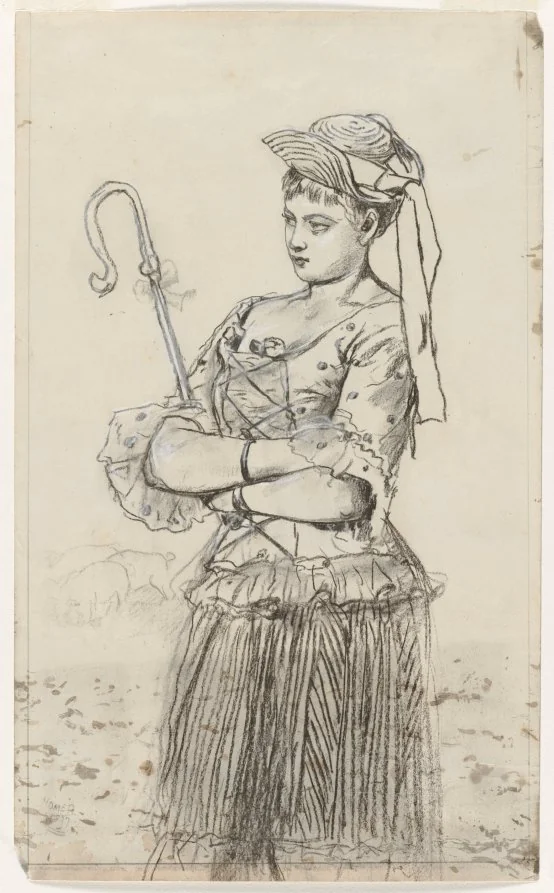
Homer spent the summer of 1878 at Mountainsville, New York, where his brother's business partner, Lawson Valentine, had a country place called Houghton Farm. While there he developed pastoral images of shepherdesses. The flirtatious quality of these depictions becomes intriguing when we consider that Homer never married, and that he worked not only from female models but also sometimes from boys in girls' clothing.
Provenance
[]
Accession Number
1924.489
Medium
charcoal with brush and brown wash, heightened with white chalk; framing lines in graphite
Dimensions
Sheet: 41.8 x 25.8 cm (16 7/16 x 10 3/16 in.); Image: 41 x 24.1 cm (16 1/8 x 9 1/2 in.)
Classification
Drawing
Credit Line
Gift of Dr. J. A. Vincent
Tags
Color: White Color: Gray
Background & Context
Background Story
Winslow Homer's "Shepherdess" (c. 1878) depicts a young woman tending sheep in a pastoral landscape, executed in charcoal with brush and brown wash, heightened with white chalk. This work dates from Homer's transition period after his return from a formative trip to France and before his famous seclusion on the coast of Maine. During the 1870s, Homer produced a remarkable series of works focused on rural American life, particularly women and children in pastoral settings. The shepherdess theme has deep roots in Western art, evoking classical and biblical associations of innocence, care, and the simple life. Homer transforms this traditional subject through his distinctly American sensibility: his shepherdess is not an idealized Arcadian figure but a recognizable young woman, likely from rural New England or Virginia, dressed in period clothing. The mixed-media technique—combining charcoal, wash, and chalk—allows Homer to achieve both atmospheric depth and textural variety, with the white chalk highlights lending luminosity to the figure and landscape. This drawing shows Homer's mastery of monochromatic media before he fully committed to the watercolors that would define his later career.
Cultural Impact
Homer's pastoral works from the 1870s represent a defining moment in American art, when the nation's artists sought to create a distinctly American visual identity rooted in the realities of rural life rather than European artistic conventions.
Why It Matters
The "Shepherdess" showcases Homer's remarkable draftsmanship and his ability to imbue a traditional pastoral subject with fresh, authentic American character, bridging European artistic traditions and the emerging American realist sensibility.