Accession Number
1924.550
Medium
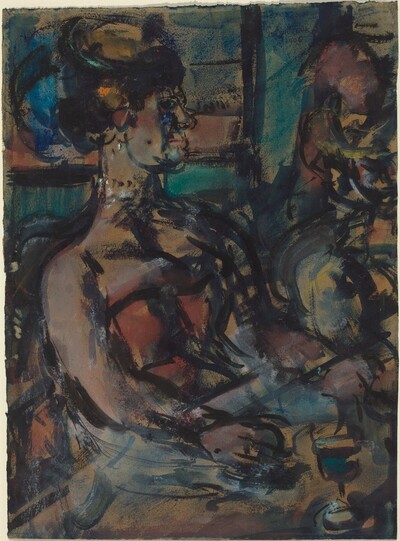
black crayon and watercolor, with gouache (main figure); black crayon (partially erased, left head); black crayon (right head)
Dimensions
Sheet: 26.7 x 18.7 cm (10 1/2 x 7 3/8 in.)
Classification
Drawing
Credit Line
Dudley P. Allen Fund
Tags
Drawing Early Modern (1901–1950) Watercolor Gouache Czech Color: White
Background & Context
Background Story
Emil Orlik (1870-1932) was a Czech-Austrian painter and printmaker known for the precisely observed prints and paintings of Japanese and Chinese subjects that make him one of the most important European artists influenced by East Asian art in the early 20th century. Chinese Actor and Two Sketches of a Woman's Head from 1912 depicts Chinese theatrical subjects in the precisely observed, atmospheric manner that distinguishes Orlik's best East Asian subjects from the more exoticized work of many of his contemporaries. Orlik traveled to Japan in 1900-01 and was deeply influenced by Japanese art, and the 1912 date places this in his mature period, when he was producing the precisely observed East Asian subjects that are his most accomplished works.
Cultural Impact
Chinese Actor and Two Sketches of a Woman's Head is important in the history of European Japonisme because it demonstrates the precisely observed, atmospheric manner that Orlik brought to East Asian subjects as one of the most important European artists influenced by East Asian art. Orlik's precisely observed East Asian subjects—based on firsthand observation during his travels in Japan and China rather than exotic fantasy—represent one of the most accomplished traditions in European Japonisme, and the 1912 print shows this tradition at its most precisely observed.
Why It Matters
Chinese Actor and Two Sketches is Orlik's Japonisme: Chinese theatrical subjects rendered in the precisely observed manner of one of the most important European artists influenced by East Asian art. The 1912 print shows the combination of firsthand observation with East Asian artistic influence that makes Orlik one of the most accomplished European artists in the Japonisme tradition.